TICKETSFree
Access to the grounds and exterior is free. Check the official Historic Environment Scotland page for current access conditions before travelling.
 Beta
Beta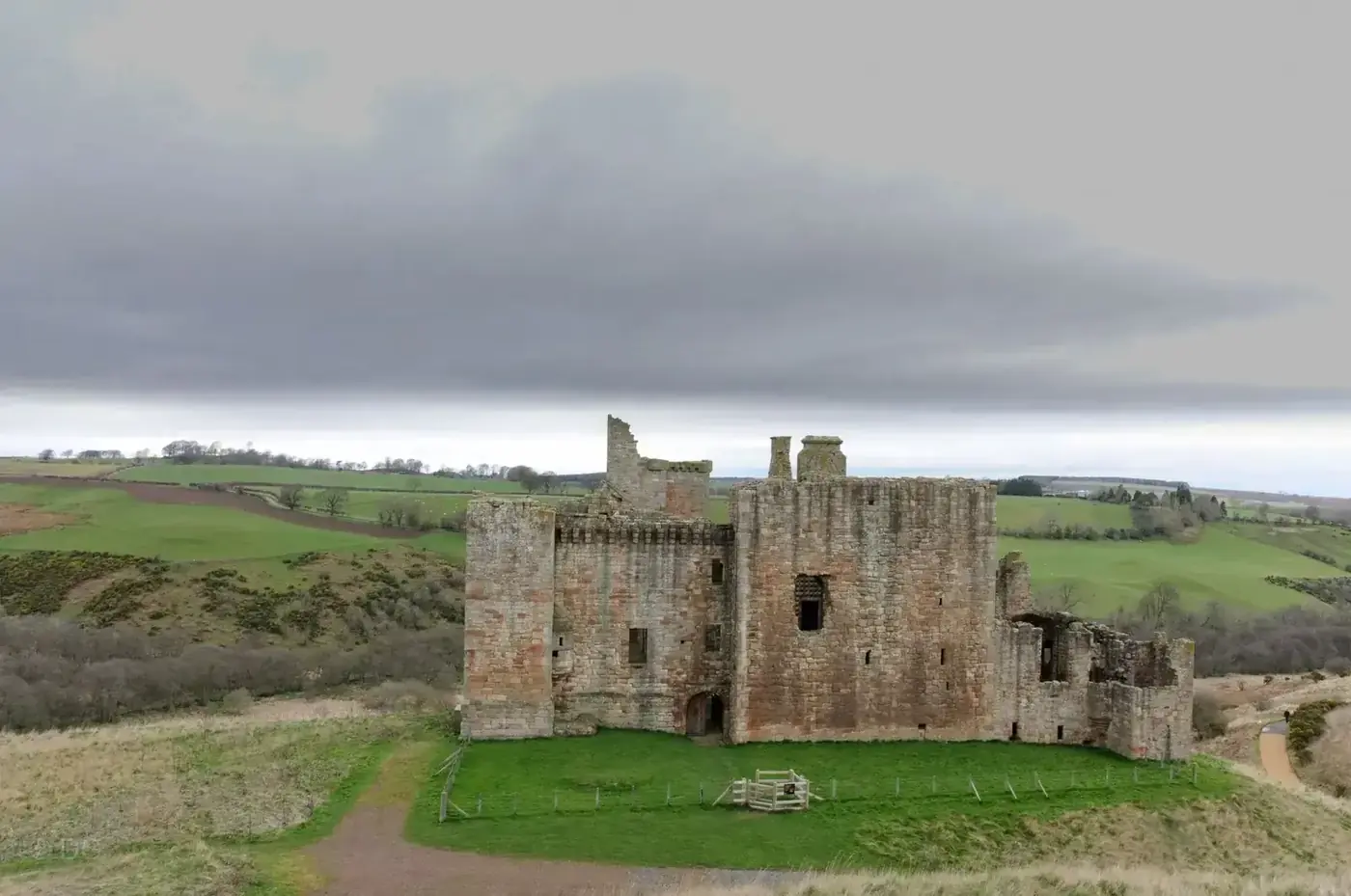
Scotland/Midlothian/Crichton Castle
RENAISSANCE COURTYARD · MIDLOTHIAN
A tower house transformed. Italian ideas in Scottish stone.
PLAN YOUR VISIT
Crichton, Pathhead, EH37 5XA
VISIT TIME: 1–1.5 hoursAccess to the grounds and exterior is free. Check the official Historic Environment Scotland page for current access conditions before travelling.
Opening arrangements, admission and access can change. Check the official visitor source before you travel.
Crichton Castle rewards a little time outdoors. Plan for the final approach as part of the visit.
Historic ground can include uneven paths, steps and exposed conditions. Wear suitable footwear.
WHAT TO EXPECT
01 / THE STORY
From the valley, Crichton looks like a strong, rather stern Scottish ruin. Its best-known surprise belongs to another mood entirely: a courtyard wall covered in projecting stone diamonds.
That unexpected touch of Italy is the thread to follow. Behind the weathered exterior was a household interested in fashion, travel and making an impression—not only in keeping enemies outside.
The quiet valley setting and unusual architecture give Crichton a character of its own. It is an appealing place for people who like a small discovery rather than a famous name on every itinerary.
Be clear about the visit before travelling: current access may be limited to the grounds and exterior. The celebrated courtyard is a reason to learn about the castle, but photographs of it are not a promise that you can enter today.
Francis Stewart, Earl of Bothwell, added the remarkable Renaissance frontage in the late sixteenth century. Its diamond-shaped stonework drew on Italian architectural fashion.
The effect is wonderfully unexpected in a rural Scottish stronghold. Light and shadow make the surface appear almost patterned like fabric. This was a wall intended to be noticed, not simply a wall intended to stand.
Crichton began as a medieval tower house before later owners enlarged it around a courtyard. That older defensive core and the elegant additions belong to different ambitions.
Think of the place as a house that kept receiving more confident alterations. One generation needed a secure base; another wanted visitors to see that its owner knew the wider world.
Mary, Queen of Scots attended the wedding celebrations of her half-brother John Stewart and Janet Hepburn at Crichton in 1562.
For a moment, imagine a busy household preparing for a royal guest and a family celebration. It is a warmer scene than the battles and imprisonments that so often follow Mary through castle guides.
02 / VISUAL JOURNAL
Every photograph on this page was made by CastleScotland during personal field visits.
10 of 18 photographs
01 / THE STORY CONTINUES
In 1589, Bothwell’s house arrest was moved to nearby Borthwick so he could visit Crichton daily to supervise his building work.
It is an oddly relatable detail in a turbulent life: even a nobleman in trouble with the king wanted to keep an eye on the renovations.
Give the approach some attention. The open valley and the separate building beside the castle help it feel like the remains of a working estate, rather than a monument isolated from everything around it.
From public, permitted viewpoints, look at the contrast between the compact mass of stone and the space surrounding it. A distant photograph can say more here than a hurried close-up at a barrier.
Check Historic Environment Scotland’s current access notice before making plans. If the interior is closed, decide whether the setting and exterior suit the outing you want.
Expect country paths and uneven ground. Crichton is best approached as a quiet stop with time to look, rather than a substitute for a fully open castle with furnished rooms.
03 / MOMENTS IN STONE
The surviving Crichton tower house takes shape. The faceted courtyard façade is Crichton’s unmistakable signature.
Francis Stewart, fifth Earl of Bothwell, creates the Renaissance lodging; HES dates it to the 1580s or around 1590. The buildings record a shift from defence toward Renaissance display.
The castle is recorded as ruined and abandoned. Its rural setting offers a calm contrast to the capital’s headline sites.
04 / FIND THE CASTLE
55.846500,-2.965900
Crichton Castle is at Crichton, Pathhead, EH37 5XA. Check current access arrangements before travelling.
Open mapOpening arrangements, admission and access can change. Check the official visitor source before you travel.
Crichton Castle rewards a little time outdoors. Plan for the final approach as part of the visit.
Walk the perimeter before choosing a viewpoint; the setting often tells as much of the story as the masonry.
History and visitor advice: CastleScotland fieldwork and official operator sources.
The surviving tower house is generally dated to around 1400. Historic Environment Scotland also describes it as late fourteenth century; neither wording supplies an exact foundation year. It stands in the east range and was the nucleus of a larger residence. The distinction matters: the castle did not emerge complete in a single moment, and the earliest surviving masonry need not mark the first occupation of the site.
In the fifteenth century, William Crichton, Chancellor of Scotland under James II, enlarged the residence. The south range contained an impressive hall, while kitchens and accommodation occupied the western side. These spaces invite a reading of the castle as a household: receiving visitors, feeding retainers and displaying rank were as important to its owners as controlling entry. Not every wall should therefore be understood as a response to an attack.
The most theatrical transformation belongs to Francis Stewart, fifth Earl of Bothwell, in the late sixteenth century. The dating varies within HES publications: the monument record gives the 1580s, while its detailed assessment describes work around 1590. A late-sixteenth-century date is safer than a precise year. The north lodging combines an arcaded lower level with diamond-faceted stonework above. It brought continental Renaissance ideas into a residence whose older ranges remained recognisably medieval.
That contrast is the heart of Crichton’s appeal. The projecting stone faces catch light differently from a flat wall, and repeated arches establish a more ordered rhythm than the older tower. Try comparing the façades in photographs before focusing on individual details. The interesting question is not simply whether the new work was more luxurious, but how its designer made an ambitious addition coexist with an inherited house.
Crichton’s residential life declined after its late-sixteenth-century splendour. HES records the castle as ruined and abandoned by 1659, and it entered state guardianship in 1926. The designation protects it as scheduled monument SM13585. The surviving building is consequently both an architectural document and a conservation responsibility; a picturesque ruin is not a building that has stopped needing care.
Archaeology adds another layer. John Lewis published an excavation report on Crichton in the Proceedings of the Society of Antiquaries of Scotland. The existence of an archaeological report is not a reason to treat every reconstruction as settled: buried remains, standing masonry and written records answer different questions. The monument record identifies further archaeological potential around the castle, including areas connected with its construction and occupation.
For a visit, keep historical interpretation separate from present access. HES currently describes the castle as closed and fenced for conservation, with the surrounding grounds open. Do not assume that the courtyard or interior shown in photographs will be accessible. The exterior setting can still be rewarding, but check the official notice before travelling. Respect the barriers, and use the images here to study details that cannot presently be approached. Crichton’s strongest impression comes from that meeting of a rural landscape, an older tower and a surprisingly adventurous Renaissance design.
08 / EXPLORE NEXT
Find Scottish castles by region, landscape or the stories that bring them to life.
 MidlothianRoslin Castle
  The HighlandsArdvreck Castle
  Edinburgh & The LothiansDunbar Castle