TICKETSNo routine ticketed entry; check local access before travel.
Visitor conditions are stated conservatively from current official or local guidance; always confirm before travel.
 Beta
Beta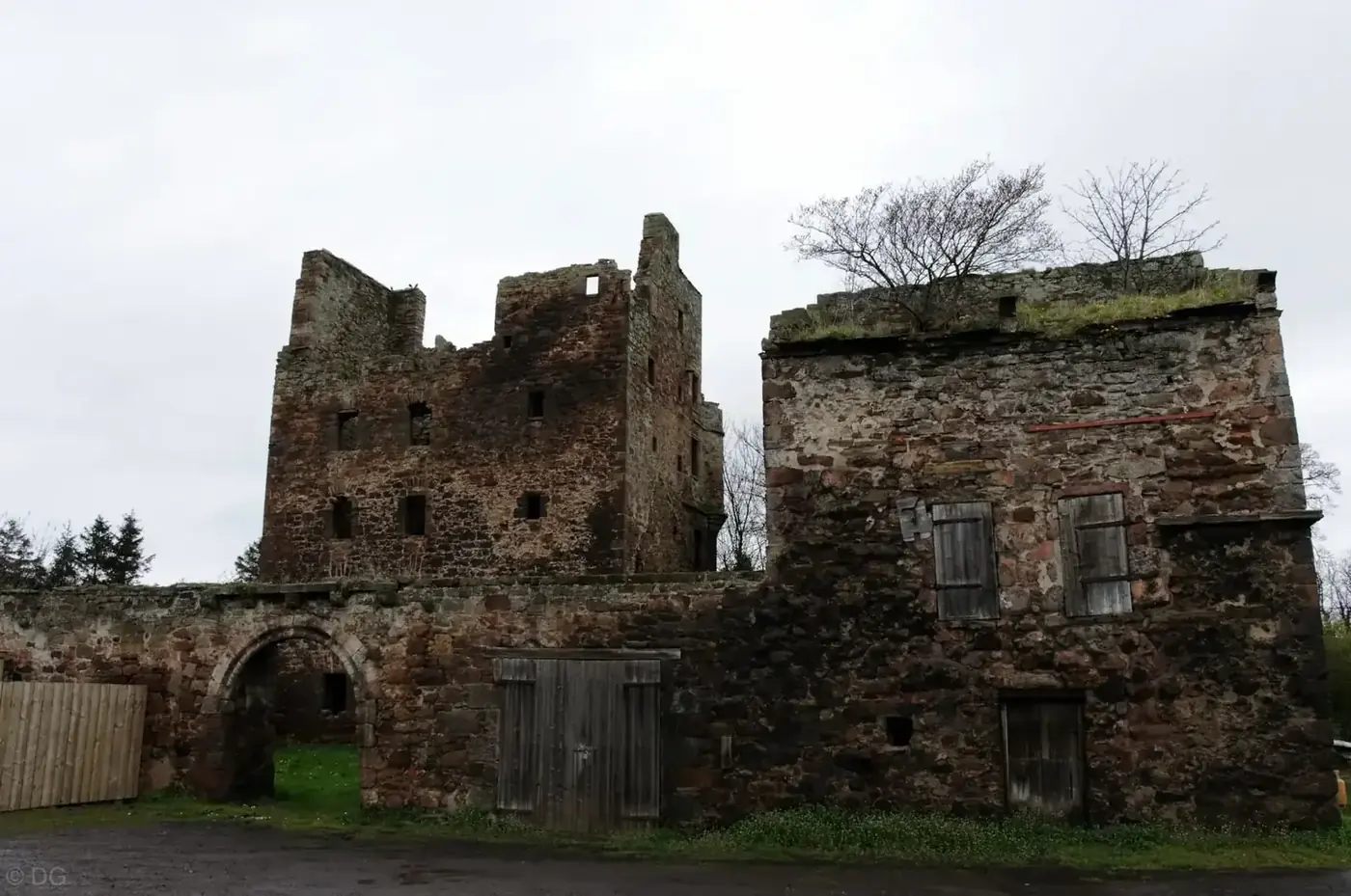
Scotland/Edinburgh & The Lothians/Redhouse Castle
FIELD GUIDE · EDINBURGH & THE LOTHIANS
A Scottish castle story. Read through its landscape.
PLAN YOUR VISIT
Near Longniddry, East Lothian
VISIT TIME: 20–40 minutesVisitor conditions are stated conservatively from current official or local guidance; always confirm before travel.
No routine ticketed entry; check local access before travel.
Use the address and map link above for Redhouse Castle. Allow time for the final rural approach and check parking guidance before setting out.
The ruin is fragile and routes may cross private estate land.
WHAT TO EXPECT
01 / THE STORY
Redhouse Castle rises from the East Lothian countryside in warm red stone, its roofless walls still suggesting a substantial family home. This is not a battlefield ruin in need of an invented siege.
Its interest is quieter: a residence enlarged in stages, an inscription linking two people to the house, and the survival of domestic spaces within a former courtyard.
The colour and scale make the ruin a strong sight from the surrounding landscape. Look for the difference between the older southern work and the later northern addition.
Access is sensitive and conditions can change. Use public viewpoints, respect private land and do not enter unstable masonry.
The surviving complex belongs broadly to the late sixteenth and early seventeenth centuries. Historic records recognise successive building phases rather than one perfectly uniform design.
That gradual growth is visible in changes of masonry and plan. A family could enlarge its home while keeping useful older rooms.
02 / VISUAL JOURNAL
Every photograph on this page was made by CastleScotland during personal field visits.
01 / THE STORY CONTINUES
John Laing and Rebecca Dennistoun are associated with the house and an inscription dated 1607. Their names bring a human pair into a story often reduced to architectural labels.
The later Hamilton connection came through marriage, another reminder that estates often changed families through relationships rather than capture.
Doorways, fireplaces and window positions are better clues here than battle legends. Follow them visually to reconstruct floors and rooms that no longer survive.
A wide exterior view also shows how the residence sat within its agricultural setting. That working landscape was part of the household’s wealth.
03 / MOMENTS IN STONE
The surviving house contains successive building phases. coastal East Lothian near Longniddry is essential to the way this castle is understood.
John Laing and Rebecca Dennistoun are associated with the house and inscription. The surviving house contains successive building phases.
The Hamilton connection follows through marriage. Current access is part of the guide: check the official or local notice before making the final approach.
04 / FIND THE CASTLE
55.983611,-2.862771
Redhouse Castle is at Near Longniddry, East Lothian. Check current access arrangements before travelling.
Open mapNo routine ticketed entry; check local access before travel.
Use the address and map link above for Redhouse Castle. Allow time for the final rural approach and check parking guidance before setting out.
Photograph Redhouse Castle as part of its setting. A wide view is often more truthful than a close crop, and all original masonry should be observed without climbing or crossing boundaries.
History and visitor advice: CastleScotland fieldwork and official operator sources.
John Laing, a keeper of the signet, and his wife Rebecca Dennistoun are associated with the house in 1607. Their initials appear in the recorded doorway inscription. This provides a more specific starting point than attributing the whole residence simply to the Hamiltons. The later Hamilton connection followed through marriage. As elsewhere, a family association should be separated from a claim to have constructed every surviving part. Ownership, occupation and architectural work overlap, but they are not interchangeable categories of evidence.
Some older descriptions contain a chronological difficulty in their account of earlier landownership. The HES legacy listing places a Douglas reference in 1655 before its account of Laing in 1607. That sequence cannot be accepted as written, and the intended earlier date has not been securely established here. Rather than silently correcting a possible typographical error, this guide keeps the supported Laing association and leaves the disputed detail unresolved. A source can be valuable for architecture while still requiring scrutiny in its historical summary.
Look at the red masonry, but remember that the walls were formerly harled. The colour visible today should not automatically be treated as the complete intended historic appearance. Lost finishes can change a building’s character as substantially as missing roofs. Openings, stone dressings and the joins between phases offer further clues. An exterior photograph records the present ruin; it is not a transparent view of the occupied house in 1607. Keeping that difference in mind makes the observation more informative.
The courtyard and dovecot extend the story beyond the main residential shell. They suggest an estate setting with functions that cannot be reduced to the tower’s skyline. Where access permits, look for the relationships between the standing elements rather than isolating each as a separate attraction. The house was part of a broader arrangement. Missing structures and altered ground can make that arrangement harder to read, but they should not be replaced with a confidently imagined plan unsupported by the surviving evidence.
The later history includes further changes of ownership and eventual ruin. The sources checked do not establish one securely dated destruction that explains the entire present condition. It is better to retain that limit than attach the loss of every roof and floor to a convenient political episode. A resident’s involvement in national events would not, by itself, prove what happened to the building. Redhouse can be appreciated through its domestic history without requiring a dramatic final catastrophe to complete the narrative.
For a visit, check local arrangements and respect boundaries around the remains. Choose a wide view to show the estate context, then a closer view of the masonry and entrance details. The strongest account brings the two together: an evolving house, recognisable owners and a shell whose present appearance differs from its furnished and finished past. Redhouse’s appeal lies in those tangible contrasts. Its red walls are memorable, but the careful distinction between surviving evidence and unresolved detail makes the history worth carrying away.
08 / EXPLORE NEXT
Find Scottish castles by region, landscape or the stories that bring them to life.
 Edinburgh & The LothiansSaltcoats Castle
  Edinburgh & The LothiansLauriston Castle
  Edinburgh & The LothiansEdinburgh Castle