TICKETS£18.50
2026 prices: online in advance / walk-up, checked on the official Stirling Castle ticket page.
 Beta
Beta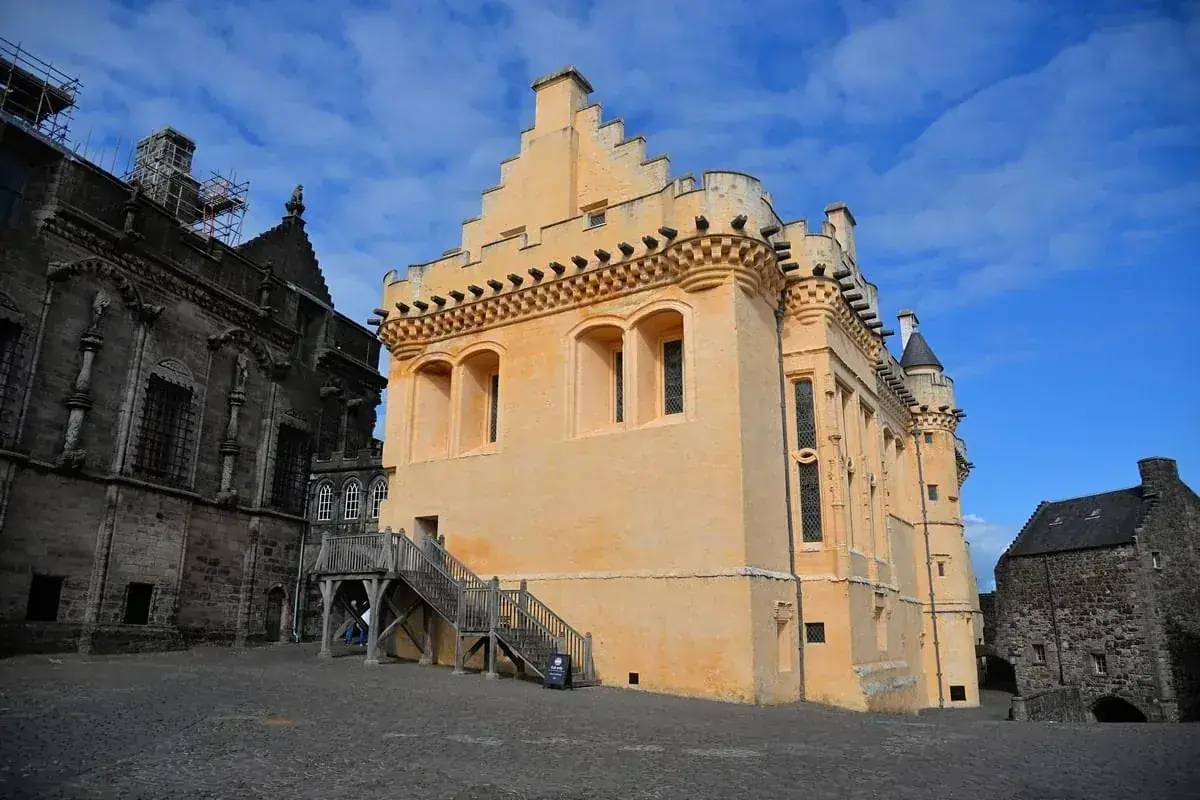
Scotland/Stirling & Forth Valley/Stirling Castle
THE KEY · STIRLING
A royal court above the Forth. Scotland in miniature.
PLAN YOUR VISIT
Castle Esplanade, Stirling, FK8 1EJ
VISIT TIME: 2–3 hours2026 prices: online in advance / walk-up, checked on the official Stirling Castle ticket page.
Book ahead in busy months and check the day’s timetable.
Stirling station is within walking distance, but the final approach rises steeply.
There are cobbles, slopes and historic stairways.
WHAT TO EXPECT
01 / THE STORY
From Stirling Castle, the landscape does much of the explaining. Look towards the Forth and the distant hills: this was a place from which rulers could watch movement across the heart of Scotland.
But step into the courtyards and another Stirling appears. Behind the defences is a royal world of grand rooms, carved faces and buildings designed to impress. Come for the fortress; stay for the palace.
Stirling offers a satisfying mix of open-air views and royal interiors. You can move from a windswept lookout to rooms that ask you to imagine colour, ceremony and the bustle of a court.
It suits a slower visit. Give the palace and Great Hall their own time instead of trying to fit every room into a quick circuit.
The castle stands above important routes and crossings of the River Forth. Long before modern roads, controlling movement through this landscape was a source of power.
Look out before looking in. The relationship between the crag, the river and the surrounding country makes the scale of the defences easier to understand.
James IV added the Great Hall around 1503. It was a place for royal occasions, where the room itself helped announce the importance of its host.
Stand back and take in its height before searching for small details. A great hall was not simply somewhere to eat: it was somewhere to be seen. The restored building helps bring that public side of monarchy into focus.
02 / VISUAL JOURNAL
Every photograph on this page was made by CastleScotland during personal field visits.
10 of 22 photographs
01 / THE STORY CONTINUES
Around 1540, James V created the Royal Palace. Its ambitious decoration belongs to the Renaissance, not to a world of bare stone and endless warfare.
The sculpted figures outside invite a closer look. Inside, the presentation of the royal apartments encourages a different picture of castle life: richer, brighter and more concerned with status than the familiar grey fortress suggests.
You do not need to remember every royal name to enjoy Stirling. Follow the change between the open courtyards, the large ceremonial spaces and the more intimate rooms.
Ask a simpler question in each place: who was meant to come here, and what impression were they meant to take away? That turns a sequence of buildings into a glimpse of life at court.
Allow time for both the buildings and the viewpoints. Comfortable shoes help on the slopes and historic surfaces; check the official access guide if stairs or uneven ground are a concern.
Use the current official booking page for admission and opening arrangements. The best finish is often another look across the Forth, now with a better sense of why this rock mattered.
Stirling has been welcoming film crews for decades. Kidnapped (1971), starring Michael Caine, is among the productions filmed at the castle. It is an entertaining connection for anyone who enjoys an old-fashioned Scottish adventure.
As you explore, imagine the everyday work of turning a royal fortress into a film set: visitors out of shot, modern details hidden, and centuries of stonework ready for another story.
03 / MOMENTS IN STONE
Stirling is recorded as a royal centre during the reign of David I. Whoever controlled Stirling could influence movement across central Scotland. That strategic geography mattered as much as the walls.
James V creates a Renaissance palace for an international court. Carved façades and recreated interiors show a court looking outward to Renaissance Europe.
Mary, Queen of Scots baptises the future James VI here. Bannockburn and the Wallace Monument turn a castle visit into a wider historical landscape.
04 / FIND THE CASTLE
56.123800,-3.948500
Stirling Castle is at Castle Esplanade, Stirling, FK8 1EJ. Check current access arrangements before travelling.
Open mapBook ahead in busy months and check the day’s timetable.
Stirling station is within walking distance, but the final approach rises steeply.
The outer defences and views across the Forth are as important as the palace rooms.
History and visitor advice: CastleScotland fieldwork and official operator sources.
During the Wars of Independence, Stirling repeatedly changed hands. Its strategic importance connected it with the battle of Stirling Bridge in 1297 and with Bannockburn in 1314, fought in the surrounding landscape rather than inside the castle. Robert the Bruce's victory at Bannockburn led to the castle's surrender and the destruction of part of its defences to prevent reuse by his enemies. Subsequent rebuilding means the surviving walls tell more than one military story.
New research reported in August 2026 offers a possible glimpse of medieval siege warfare. Skeleton 150, excavated in the castle chapel in 1997, had more than 160 fractures. According to Live Science's report of Jo Buckberry's conference presentation, micro-CT and 3D scanning helped identify injuries sustained around the time of death. The researchers consider a high-velocity projectile from a siege engine, probably a trebuchet, the most likely explanation. This remains an interpretation of the injuries: neither death during the siege of 1304 nor a strike by Edward I's War Wolf has been established.
The most imposing royal buildings belong to the later Stewart court. James IV commissioned the King's Old Building, the Great Hall and the monumental Forework. Their scale helped turn arrival at the castle into a statement of royal authority. The Great Hall was under construction around the time of his marriage in 1503. Its present appearance also owes much to modern restoration, including the replacement hammerbeam roof, rather than uninterrupted survival of every medieval fitting.
James V's palace followed in the later 1530s and early 1540s. Work associated with Sir James Hamilton of Finnart is documented from 1538, but the surviving accounts do not establish him as the sole designer. Carved façades, paired royal apartments and controlled approaches to increasingly private rooms expressed the court's status within Renaissance Europe. James died in 1542; his widow, Mary of Guise, continued to use the palace. The building's history extends beyond the lifetime of its royal patron.
Mary, Queen of Scots was crowned at Stirling Castle in 1543. Her son James was baptised here in 1566 amid celebrations arranged by the court; Mary did not herself administer the sacrament. His coronation as James VI took place in 1567 at the nearby Church of the Holy Rude, not in the castle chapel. Much of his childhood was spent at the castle. The present Chapel Royal belongs to another ceremony: it was built in 1594 for the baptism of his son Prince Henry.
The Union of the Crowns in 1603 drew the royal court towards London, although later monarchs still visited Stirling. Its military role became increasingly prominent during the seventeenth and eighteenth centuries. Royal rooms were divided into soldiers' accommodation and stores, while artillery defences reshaped the approach. The long army occupation ended in 1964. That history is still interpreted by the Argyll and Sutherland Highlanders museum in the King's Old Building.
Conservation has since recovered much of the palace's scale and colour. The royal apartments reopened in 2011 after research into inventories, accounts, surviving fabric and comparable furnishings. Their rich presentation is an informed reconstruction, not a room preserved unchanged since Mary of Guise. Original carved Stirling Heads and painted replicas should likewise be distinguished. Archaeology has revealed earlier buildings beneath the later courtyards and royal ranges.
Stirling is protected as scheduled monument SM90291 and cared for by Historic Environment Scotland. Take time for both the ceremonial interiors and the ramparts. Together they explain a royal residence that became a barracks and, eventually, a carefully interpreted historic place.
08 / EXPLORE NEXT
Find Scottish castles by region, landscape or the stories that bring them to life.
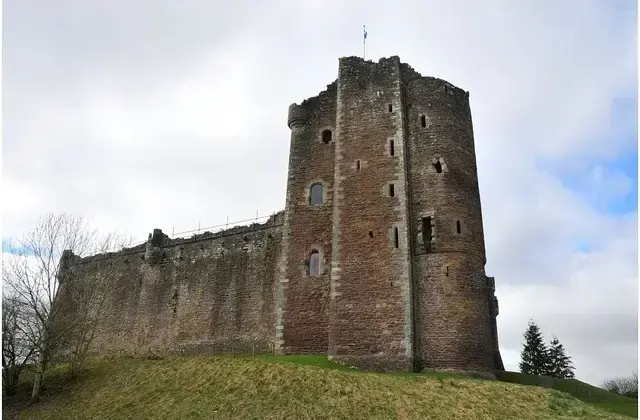 Stirling & Forth ValleyDoune Castle
 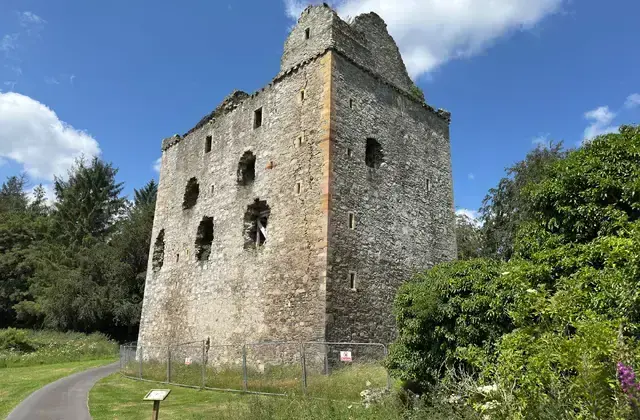 Scottish BordersNewark Tower
 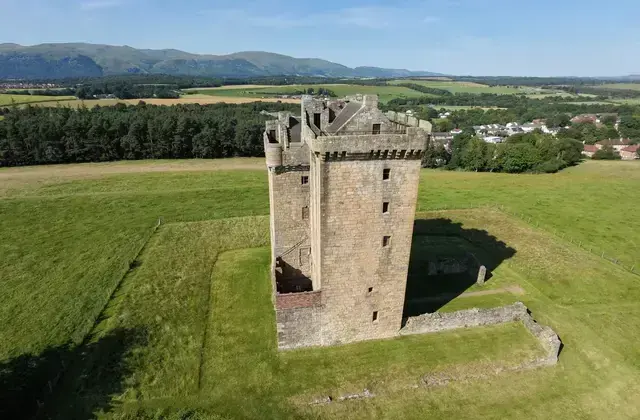 Loch Lomond, Stirling & ForthClackmannan Tower