TICKETS£7.50
Prices checked against the official Historic Environment Scotland visitor page; confirm before booking.
 Beta
Beta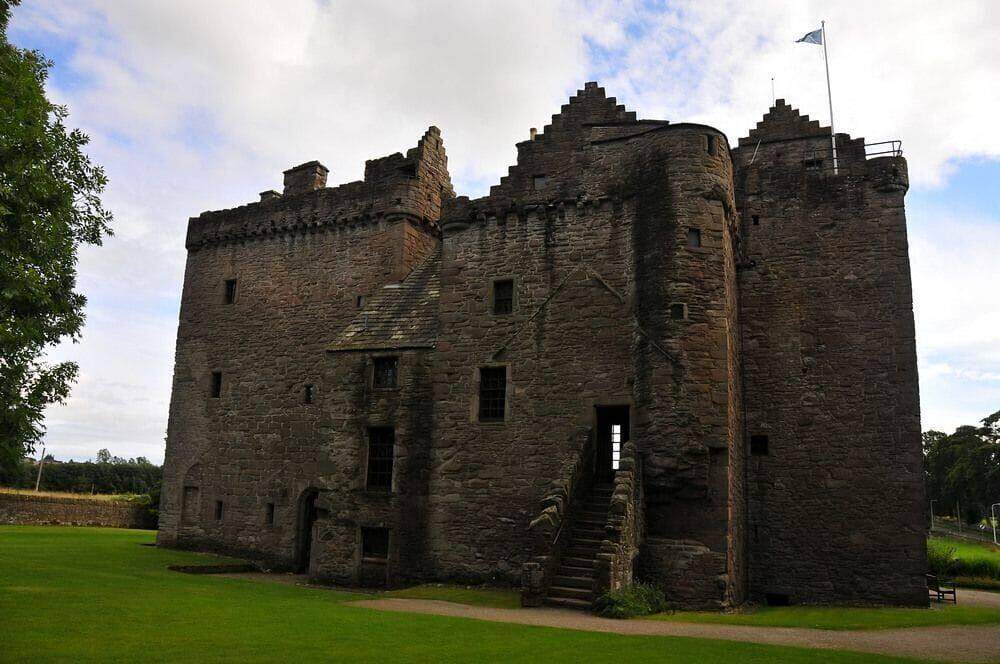
Scotland/Perthshire/Huntingtower Castle
TWIN TOWERS · PERTH
Two towers. A painted ceiling. Perthshire politics in stone.
PLAN YOUR VISIT
Huntingtower, Perth, PH1 3JL
VISIT TIME: 1–1.5 hoursPrices checked against the official Historic Environment Scotland visitor page; confirm before booking.
Check the live page for current hours and any partial-access notice.
Use the address and map link above for Huntingtower Castle. Allow time for the final rural approach and check parking guidance before setting out.
The historic interiors include stairs and uneven surfaces. Temporary conservation or wildlife restrictions can affect individual areas.
WHAT TO EXPECT
01 / THE STORY
Huntingtower looks compact from outside, yet two separate towers, rare painted decoration and a royal kidnapping pack a remarkable amount of story into the rooms.
Originally the Place of Ruthven, it became Huntingtower only after the family's political fall in 1600. Even the gap between its two buildings acquired a legend of its own.
The castle offers detail instead of overwhelming scale. Look up for painted boards and beams, then study how blocked openings reveal changing movement between the towers.
Its closeness to Perth makes it an easy stop, but allow enough time for the interiors rather than treating it as a quick exterior.
The eastern building may have begun as a fifteenth-century gatehouse before conversion into accommodation around 1500. A second tower stood about three metres away.
Late seventeenth-century work filled the gap and added a grand stair. The unusual pair became one residence through practical rebuilding.
In August 1582, nobles led by William Ruthven seized the young James VI here. The Raid of Ruthven began a period in which the group controlled access to the king.
It should not be imagined as ten months in one locked chamber. The political regime lasted longer than James's presence in a particular room.
02 / VISUAL JOURNAL
Every photograph on this page was made by CastleScotland during personal field visits.
01 / THE STORY CONTINUES
The separate Gowrie affair of 1600 happened at the family's townhouse in Perth, where John and Alexander Ruthven were killed. Their estates were forfeited.
The old family name was then stripped from the castle and replaced with Huntingtower. Renaming became punishment written onto a place.
A local tale says a young woman leapt across the three-metre gap between the towers. The former separation gives the story a physical stage visitors can understand.
There is no need to present the leap as documented escape. As folklore, it turns an unusual building joint into Huntingtower's most personal mystery.
03 / MOMENTS IN STONE
An earlier gatehouse becomes residential; two neighbouring towers develop. Painted decoration preserves the domestic ambition of the tower house.
Mary, Queen of Scots stays at the Place of Ruthven. The castle is linked to one of the most dramatic episodes of James VI’s youth.
The Raid of Ruthven begins a period of noble control over James VI. Legend turns the space between the towers into a memorable local story.
After the Gowrie affair in Perth, the forfeited castle is renamed Huntingtower.
The castle enters State care.
04 / FIND THE CASTLE
56.409455,-3.488228
Huntingtower Castle is at Huntingtower, Perth, PH1 3JL. Check current access arrangements before travelling.
Open mapCheck the live page for current hours and any partial-access notice.
Use the address and map link above for Huntingtower Castle. Allow time for the final rural approach and check parking guidance before setting out.
The paired towers are strongest from the outer approach; inside, look up for the painted ceiling rather than relying only on wide exterior views.
History and visitor advice: CastleScotland fieldwork and official operator sources.
The two towers originally stood about three metres apart. Their unusual relationship is more revealing than a simple story of two competing owners: the precise reasons for the arrangement remain uncertain. Surviving openings and blocked entrances record repeated changes in circulation. Halls, chambers and service spaces connected the household in ways that the present visit only partly preserves. The castle should be read as a developing residence, not a single construction frozen in time.
In the eastern hall, painted boards and beams carry interlaced patterns, foliage and animal forms. The ceiling is commonly dated to around 1540, but the HES assessment also records a proposed date around 1580. Its exact dating therefore deserves caution. Painted plaster survives elsewhere, reminding us that bare stone was not the intended finish of every castle room. Later conservation revealed and repaired these decorations, but also altered their appearance; what survives is neither wholly untouched nor wholly modern.
Mary, Queen of Scots stayed here in 1565, shortly after her marriage to Lord Darnley. A more coercive royal encounter followed in August 1582, when nobles led by William Ruthven, first Earl of Gowrie, seized the young James VI. The Raid of Ruthven began a period of political control over the king. It should not be imagined as a ten-month imprisonment in one Huntingtower chamber: the regime's duration and the king's location are separate questions.
The family's final downfall followed the events known as the Gowrie Conspiracy in 1600, at its townhouse in Perth. John, third Earl of Gowrie, and his brother Alexander were killed; their estates were forfeited and the Place of Ruthven was renamed Huntingtower. This was a different episode from the raid of 1582, and its setting was not this castle. Historians have offered conflicting explanations of the alleged conspiracy and its motives.
The Murrays subsequently held the castle, initially for the Crown, and acquired it in 1663. Late seventeenth-century alterations filled the gap between the towers, introducing a grand stair and an attempt at a more unified frontage. Huntingtower later declined as an aristocratic home and briefly accommodated textile workers. State care began in 1912; early conservation removed some later fittings to expose older work. The building is now protected as scheduled monument SM90164.
A local legend, the Maiden's Leap, gives the narrow gap another life: a young woman is said to have leapt between the towers. It is a story to enjoy as folklore, not evidence for a recorded escape. Between that tradition, the surviving painted rooms and the changing façades, Huntingtower offers more than a catalogue of royal names. Look closely at the junctions between buildings: they show how successive households reshaped this compact Perthshire residence.
08 / EXPLORE NEXT
Find Scottish castles by region, landscape or the stories that bring them to life.
 PerthshireDrummond Castle
  PerthshireFinlarig Castle
  PerthshireElcho Castle