TICKETS£7.50
Prices checked against the official operator page; opening is seasonal.
 Beta
Beta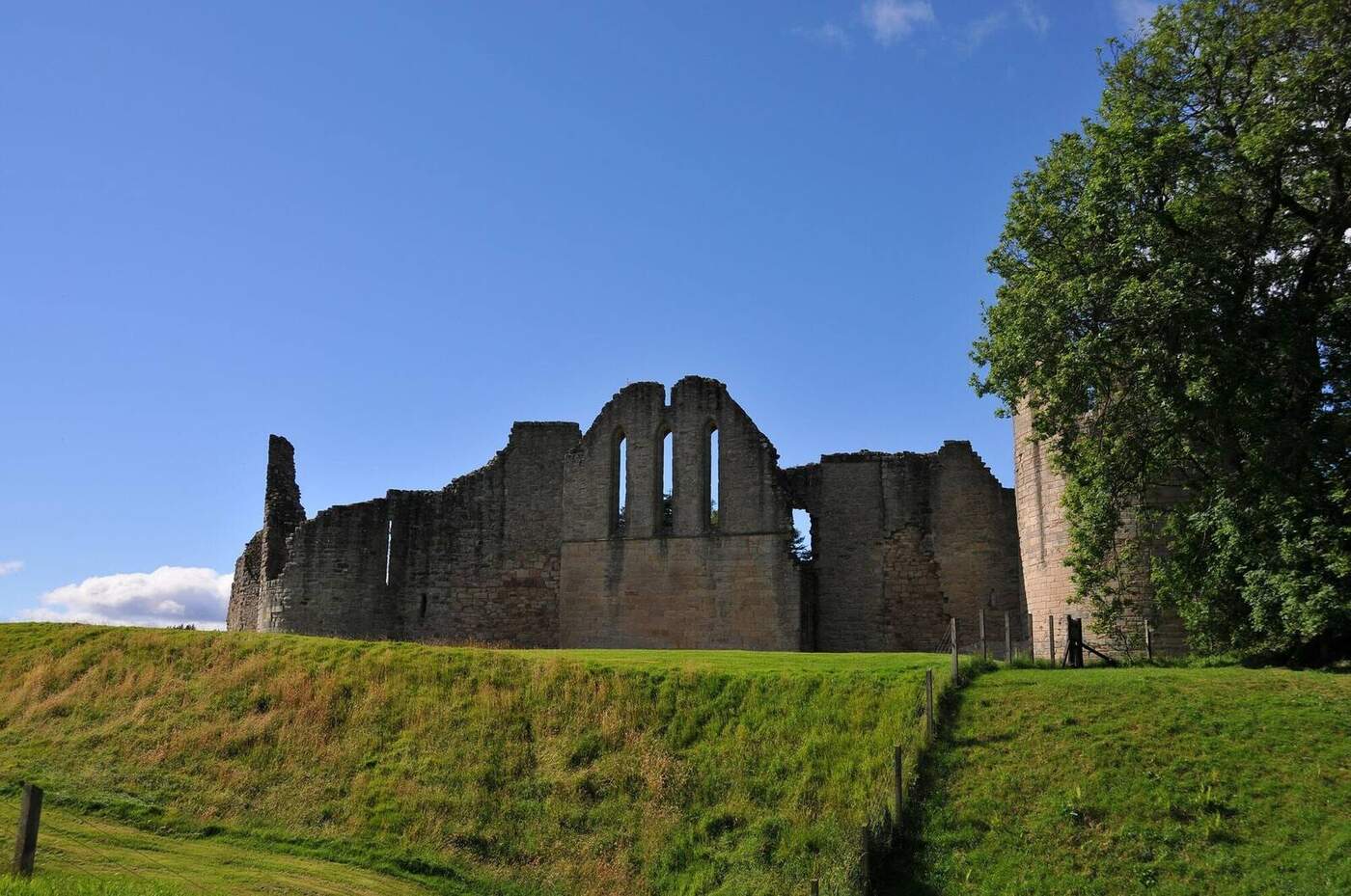
Scotland/Aberdeenshire/Kildrummy Castle
EARLS OF MAR · ABERDEENSHIRE
A northern stronghold. A siege written into its ruins.
PLAN YOUR VISIT
Kildrummy, Aberdeenshire, AB33 8RA
VISIT TIME: 1–1.5 hoursPrices checked against the official operator page; opening is seasonal.
Kildrummy is a seasonal Historic Environment Scotland site.
Use the address and map link above for Kildrummy Castle. Allow time for the final rural approach and check parking guidance before setting out.
The site has uneven ground, grass and ruined surfaces. The visitor route includes outdoor terrain rather than step-free museum circulation.
WHAT TO EXPECT
01 / THE STORY
Kildrummy was built on the scale of a regional capital. Its broad curtain wall, towers, gatehouse, hall and chapel once formed the chief stronghold of the earls of Mar.
The ruin is dramatic without needing invented tunnels or ghost stories. Two determined defences—one led by Robert the Bruce's brother, another by Bruce's sister—give it all the human tension it needs.
Walk far enough back to take in the whole enclosure. A ravine protected part of the site and a great ditch strengthened the more vulnerable approach, while towers broke up the long line of wall.
The exact foundation date is unknown. The castle was standing by 1296 and was probably begun in the mid-thirteenth century; that careful range is more honest than a single unsupported year.
In 1306, Neil Bruce defended Kildrummy while King Robert's cause was in grave danger. An English force led by the future Edward II—then Prince of Wales—captured the castle.
Neil was taken and executed. The episode was part of Edward I's campaign against the Bruce family, not a self-contained romantic siege with a happy ending.
In 1335, Christina Bruce, sister of King Robert, defended Kildrummy against David of Strathbogie, Earl of Atholl, who supported the rival Balliol cause.
Relief came under the leadership of her husband, Andrew Murray. Remembering Christina by name changes the scene: this was not simply a fortress waiting for an army, but a household actively organising its defence.
02 / VISUAL JOURNAL
Every photograph on this page was made by CastleScotland during personal field visits.
01 / THE STORY CONTINUES
The great hall and chapel mattered alongside towers and ditches. They remind us that Kildrummy was a centre of lordship, worship, hospitality and administration as well as a refuge in war.
Move from the outer defences towards the inner buildings and the castle becomes less like a diagram of a siege and more like a place where a large community lived and worked.
Kildrummy returned to the earls of Mar in 1626 and was connected with the opening phase of the Jacobite rising of 1715. That political turning point is often treated as a neat ending.
Abandonment was more gradual. Castles rarely become ruins at the stroke of one famous date, and Kildrummy is a good place to resist that tidy version of history.
03 / MOMENTS IN STONE
The castle develops as a major seat of the earls of Mar; its exact foundation date remains uncertain. Kildrummy’s plan reflects the scale of the Earls of Mar’s power.
An English force led by the future Edward II captures the castle defended by Neil Bruce. A woman-led siege defence gives the ruins an unusually vivid personal history.
Christina Bruce holds the castle until relief led by Sir Andrew Murray. Hall, gate and ranges explain that this was both home and fortress.
04 / FIND THE CASTLE
57.234922,-2.905188
Kildrummy Castle is at Kildrummy, Aberdeenshire, AB33 8RA. Check current access arrangements before travelling.
Open mapKildrummy is a seasonal Historic Environment Scotland site.
Use the address and map link above for Kildrummy Castle. Allow time for the final rural approach and check parking guidance before setting out.
The gatehouse and broad court give the strongest sense of scale; walk the perimeter before deciding on close detail shots.
History and visitor advice: CastleScotland fieldwork and official operator sources.
The plan is roughly D-shaped, with its straighter side protected by a steep ravine and a ditch guarding other approaches. This combination of landscape and masonry helps explain the fortress more clearly than a list of battles. The remains include the gatehouse, hall and chapel. A powerful residence needed spaces for ceremony, worship and household work as well as walls, and Kildrummy’s open plan makes those different demands easier to consider together.
In 1306 the castle fell to an English force led by the future Edward II, then Prince of Wales, after a defence commanded by Neil Bruce, Robert the Bruce’s brother. This was an army serving Edward I; the two royal names describe different roles in the same campaign. The capture should not be dated to 1304. The distinction prevents a visit from being organised around an event placed in the wrong year.
Kildrummy’s other celebrated defence came in 1335. Christina Bruce, Robert’s sister, held the castle against a pro-English army led by David of Strathbogie, Earl of Atholl. HES’s account credits her husband, Sir Andrew Murray, with bringing the relieving force. Christina’s defence and Murray’s intervention belong to the same episode, but they should not be collapsed into a story in which one person performed every role. Precise troop totals are best treated cautiously rather than as a modern headcount.
The castle remained politically significant long after those sieges. Its history involved changes of control between the Mar interest, the Crown and other noble families. HES records a return to the Mar family in 1626, and its connection with the opening stages of the Jacobite rising of 1715. This later history matters because the ruins were not simply a monument to the Wars of Independence left untouched for centuries.
Abandonment was also a process. HES’s detailed assessment considers evidence for declining occupation after the rising, while allowing that some use may have continued later. It is therefore too neat to say that every room became empty on a single day in 1715. Surviving walls can record rebuilding, demolition and gradual loss as well as dramatic destruction. The present absence of a roof does not by itself identify the event that removed it.
Archaeological investigation has helped establish the building’s development. Michael R Apted’s published report covers excavation between 1952 and 1962. That is evidence of systematic study, not permission to invent particular finds. The castle is protected as scheduled monument SM90181, and the designation recognises both its standing remains and the potential of buried material. Preservation includes what cannot be seen during an ordinary walk around the ruins.
Begin with the overall enclosure, then compare the domestic ranges with the defensive approach. Try to imagine movement between the gate, hall and chapel without assuming that all visible features belong to the same century. This is a place for reading a plan slowly rather than collecting a single summit view. The Bruce family connections give Kildrummy a vivid human story, but its larger achievement is showing how a substantial household and an important fortress occupied the same space. Check the official page for current visiting arrangements before setting out.
08 / EXPLORE NEXT
Find Scottish castles by region, landscape or the stories that bring them to life.
 AberdeenshireDunnottar Castle
  AberdeenshireHuntly Castle
  AberdeenshireBraemar Castle