TICKETSFree
Current status is based on the Trust’s restoration information; local signs and access rules always take priority.
 Beta
Beta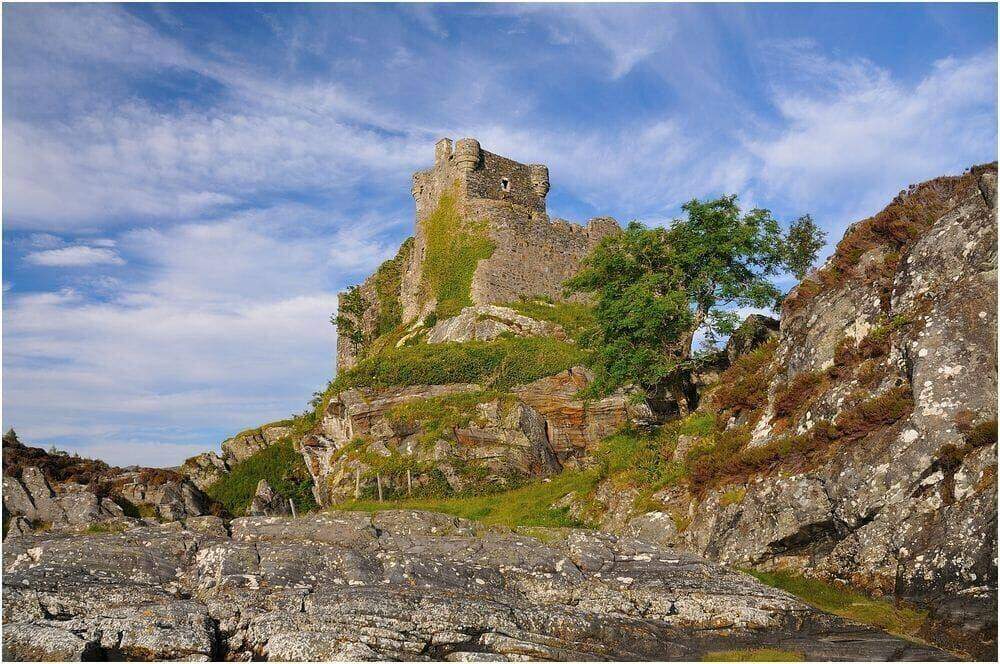
Scotland/The Highlands/Castle Tioram
TIDAL ISLAND · LOCH MOIDART
A clan stronghold. Seen across the changing tide.
PLAN YOUR VISIT
Loch Moidart, near Acharacle, PH36 4JZ
VISIT TIME: 30–60 minutesCurrent status is based on the Trust’s restoration information; local signs and access rules always take priority.
There is no standard admission ticket and no public interior access. View the castle from public, permitted ground near Loch Moidart; check local notices, tide information and the Trust’s current updates before setting out.
Use the address and map link above for Castle Tioram. Allow time for the final rural approach and check parking guidance before setting out.
The island and ruin are not a managed, step-free attraction. Ground can be wet, uneven and affected by the tide; never cross boundaries or attempt entry.
WHAT TO EXPECT
01 / THE STORY
Castle Tioram stands on a tidal island in Loch Moidart on Scotland’s west coast. Its ruined enclosure rises above rock and water, creating a striking view that changes with the tide and weather. This is an exterior-viewing destination, not a restored castle with public rooms to tour. Our guide combines original photographs with the history of the stronghold and practical advice for approaching the surrounding landscape responsibly.
Tioram became a major seat of the MacDonalds of Clanranald within the Gaelic maritime world of the western Highlands. Its walls and domestic buildings developed over generations. A tradition associates Amie MacRuari with its construction, but the entire surviving castle cannot securely be assigned to one founder or year. The distinction between architectural evidence and later clan memory is central to understanding this place, rather than an obstacle to enjoying its story.
Plan your visit around permitted viewpoints and current local conditions. A tidal causeway is not a guarantee of safe access: water can cover the route, and low tide does not mean that entry to the ruin is allowed. Follow signs and barriers, check suitable local tide information and do not attempt to enter closed areas. From the shore, the relationship between island, enclosure and loch is often more revealing than a close view of one wall. Use the map to locate Tioram before your journey and allow time for the final approach rather than relying on a simple distance from Fort William.
The shoreline, tide and enclosing wall create the experience. A wide photograph shows why a sea loch connected this stronghold to a maritime Gaelic world.
The interior is closed because the ruin is unsafe. Low tide is not permission to enter, and the causeway can be covered again quickly.
An enduring clan tradition credits Amie MacRuari with building at Tioram in the mid-fourteenth century. The castle trust presents the attribution as tradition.
The curtain wall may be thirteenth-century, and the complex developed over generations. Amie's place in memory is significant without making her the certain builder of every wall.
Sixteenth- and seventeenth-century occupants enlarged domestic ranges, opened larger windows and improved circulation. A 1668 letter discusses repairs and a shortage of timber.
That practical document reveals a house requiring maintenance. Tioram was not a timeless shell between moments of clan warfare.
02 / VISUAL JOURNAL
Every photograph on this page was made by CastleScotland during personal field visits.
01 / THE STORY CONTINUES
A report by military engineer David Watson described rebels capturing a government detachment and burning the castle in 1715. Later Clanranald accounts connect the action with Allan MacDonald.
The reported motive was to deny the stronghold to government forces. Damage ended normal residential use, though it cannot prove every sheltered space remained forever empty.
Castle Tioram appeared in Rob Roy (1995) as part of the Duke of Argyll's estate. Cinema gave the Clanranald stronghold a different noble identity.
The tidal setting needed little decoration to look remote and powerful. Enjoy the film connection from the legal shoreline viewpoints that preserve the real ruin.
03 / MOMENTS IN STONE
The enclosure develops; its exact founder is uncertain. Water alters the visual and practical relationship between shore and castle.
Domestic ranges are remodelled and enlarged. Tioram belongs to the maritime history of Gaelic western Scotland.
Jacobite forces burn the castle. The closure is part of responsible interpretation, not an invitation to trespass.
The castle and island are scheduled.
Scheduling remains after removal of the separate listing.
04 / FIND THE CASTLE
56.784544,-5.829299
Castle Tioram is at Loch Moidart, near Acharacle, PH36 4JZ. Check current access arrangements before travelling.
Open mapThere is no standard admission ticket and no public interior access. View the castle from public, permitted ground near Loch Moidart; check local notices, tide information and the Trust’s current updates before setting out.
Use the address and map link above for Castle Tioram. Allow time for the final rural approach and check parking guidance before setting out.
The best image is often the widest one: place the castle low in the frame and allow tide, shore and cloud to describe the distance.
History and visitor advice: CastleScotland fieldwork and official operator sources.
An enduring tradition credits Amie MacRuari, mother of Ranald, with building at Tioram around the middle of the fourteenth century. The Caisteal Tioram Trust presents this explicitly as tradition and notes earlier charter evidence and architectural comparisons. The story can be retained, but it does not securely establish that Amie built the entire surviving enclosure. A named woman in clan memory and an uncertain building chronology should not be forced into a falsely exact foundation date.
The castle served the lordship of Garmoran and later Clanranald. Its position near the Shiel estuary helps explain its importance within a network of sea routes and inland approaches. Highland Council’s historic record describes an early tower on the eastern side and substantial domestic accommodation along the south. Different surveys have dated parts of this sequence differently. Broad medieval origins followed by sixteenth- and seventeenth-century remodelling are more defensible than assigning every wall to one owner.
The later work made room for a more comfortable household. Larger windows, a stair tower and raised accommodation changed the relationship between the enclosure and the buildings within it. The record connects some alterations tentatively with early-seventeenth-century requirements for clan chiefs to maintain more formal residences. A letter of 1668 mentions repairs to the old house and a shortage of timber. That is evidence of continuing attention to a residence, rather than a fortress frozen in its first medieval form.
The burning in 1715 is much firmer ground than the founder tradition. Highland Council reproduces a report made by military engineer David Watson in 1748, describing a government detachment captured by rebels who then burned the castle. Later Clanranald accounts associate the action with Allan MacDonald. Their explanation that he intended to deny the building to government troops should be presented as the reported motive, not as direct access to his private thoughts.
Watson’s report also described a ruin that would require repairs to accommodate troops. It therefore supports substantial damage and loss of normal residential use, but not the claim that no person ever used any part of the site again. The absence of an occupied mansion is different from proof that every cellar and sheltered space remained empty thereafter.
Tioram is protected as a scheduled monument, including the island. Its separate listed-building designation was removed in 2019 while scheduling remained in force; this did not remove its protection. Modern proposals for restoration have generated disagreement over the future of the ruin. Whatever position one takes, the surviving fabric is historical evidence. Respect closures and tide conditions, and read the castle as a changing household and political centre whose uncertainties are part of the story.
Castle Tioram occupies a tidal island in Loch Moidart in the western Highlands. Use the map and directions in this guide to plan the approach.
This guide treats Tioram as an exterior-viewing destination. Do not enter the closed ruin or cross barriers. Check current local notices before visiting.
The island has a tidal connection, but tide levels, ground conditions and access restrictions must all be considered. Do not interpret low tide as permission to enter the castle or as a guarantee of a safe crossing. Choose a permitted shore viewpoint if uncertain.
Its origins and building phases remain partly uncertain. Tradition credits Amie MacRuari with building here, but the enclosing walls may be older. It is misleading to attribute the complete surviving complex to one securely identified founder.
The castle was burned in 1715. Later accounts connect this with Clanranald and the Jacobite rising; the explanation that it was intended to deny the castle to government troops is a reported motive.
Sources and current visitor information:
Compare Castle Tioram on Loch Moidart with Old Inverlochy Castle near Fort William. These are separate journeys with their own access restrictions. Check the map of Scottish castles and current visitor notices before setting out.
08 / EXPLORE NEXT
Find Scottish castles by region, landscape or the stories that bring them to life.
 The HighlandsSinclair Girnigoe Castle
  The HighlandsCaisteal Maol
  The HighlandsCastle of Mey