TICKETSFree
No admission fee; conditions depend on weather and the exposed shoreline path.
 Beta
Beta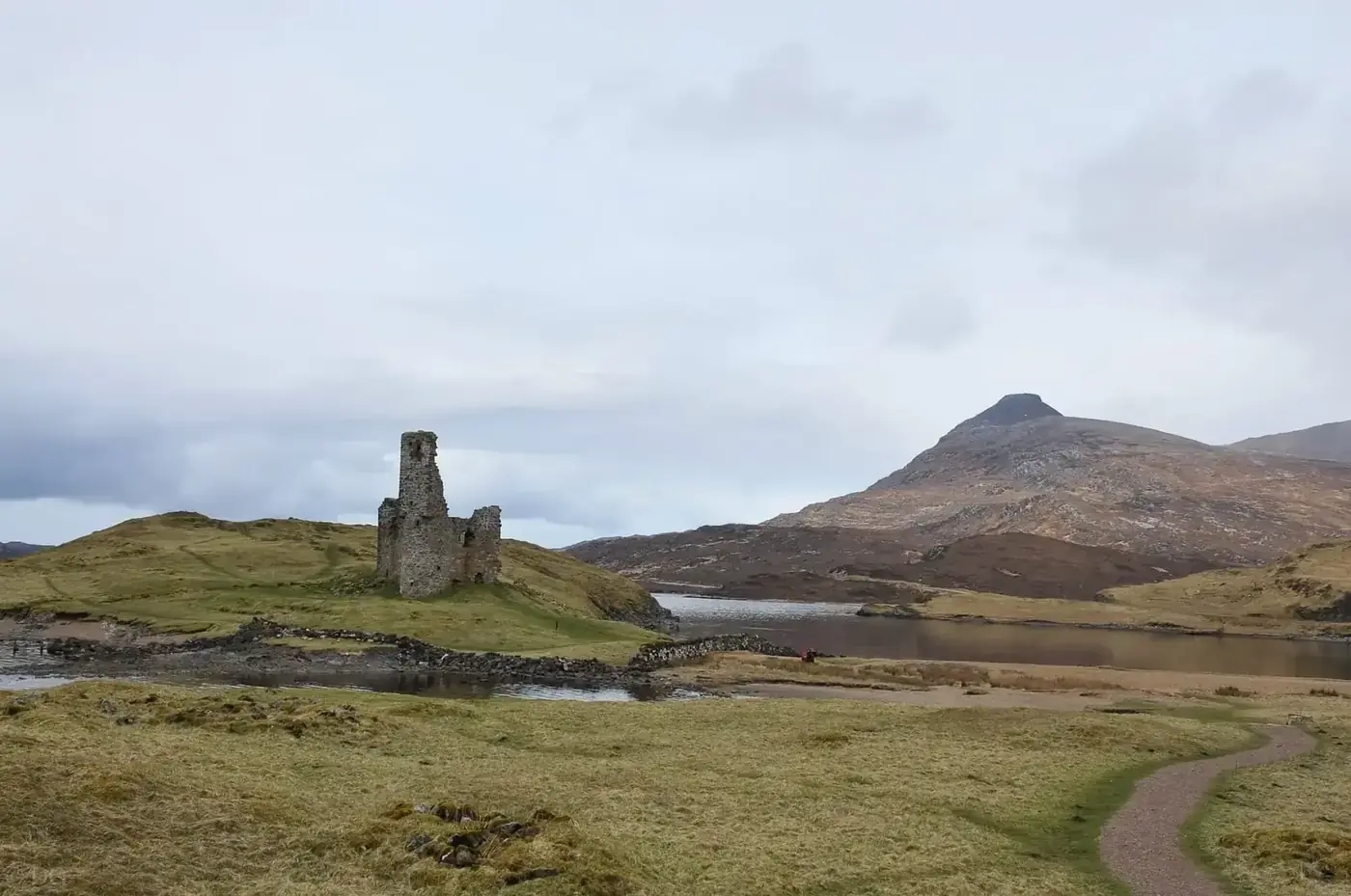
Scotland/The Highlands/Ardvreck Castle
LOCH ASSYNT RUIN · NORTH-WEST
Stone, water and mountain. A Highland story in fragments.
PLAN YOUR VISIT
Loch Assynt, near Inchnadamph, IV27 4HN
VISIT TIME: 45–75 minutesNo admission fee; conditions depend on weather and the exposed shoreline path.
There is no ticketed attraction. Parking is available near the A837; the short approach can be wet and uneven, especially after rain.
Use the address and map link above for Ardvreck Castle. Allow time for the final rural approach and check parking guidance before setting out.
Ground and stone are slippery in wet weather. Respect the ruin and do not climb walls.
WHAT TO EXPECT
01 / THE STORY
Ardvreck is a small fragment in an enormous Highland picture. Loch Assynt, mountains and sudden changes of weather give the broken MacLeod tower a presence far beyond its size.
The best documented drama came in 1650, when the defeated Marquess of Montrose was held here before being taken towards execution in Edinburgh.
The promontory makes the ruin appear almost afloat when water levels and light align. Begin with a wide view before following the remaining tower and circular stair projection.
Ground can be wet and masonry fragile. Use the established approach and do not climb the ruins.
Historic Environment Scotland generally dates the tower to the late sixteenth century. A modern archaeological survey has proposed late-fifteenth-century origins followed by later development.
An earlier phase is possible, but no single exact year resolves the evidence. The MacLeod residence grew rather than appearing fully formed.
02 / VISUAL JOURNAL
Every photograph on this page was made by CastleScotland during personal field visits.
01 / THE STORY CONTINUES
After defeat at Carbisdale in 1650, James Graham, Marquess of Montrose, was captured in Assynt and held at Ardvreck before being handed to government forces.
He was later executed in Edinburgh. The outline is documented; imagined conversations about betrayal belong to later storytelling.
Calda House was built around 1725 as a replacement residence associated with Kenneth Mackenzie. Its larger country-house form reveals changing expectations of comfort.
Seeing both ruins turns one stop into a comparison. Ardvreck and Calda are successive homes, not two versions of the same medieval castle.
03 / MOMENTS IN STONE
HES favours a late-16th-century tower; a survey also proposes an earlier phase. The promontory turns a compact ruin into one of Scotland’s most powerful landscape photographs.
Montrose is held here after his defeat and capture. HES favours a late-16th-century tower; a survey also proposes an earlier phase.
Calda House is built as a replacement residence. Current access is part of the guide: check the official or local notice before making the final approach.
04 / FIND THE CASTLE
58.166412,-4.993973
Ardvreck Castle is at Loch Assynt, near Inchnadamph, IV27 4HN. Check current access arrangements before travelling.
Open mapThere is no ticketed attraction. Parking is available near the A837; the short approach can be wet and uneven, especially after rain.
Use the address and map link above for Ardvreck Castle. Allow time for the final rural approach and check parking guidance before setting out.
Use wide views with Loch Assynt and the mountains; low cloud can be more expressive than clear sun.
History and visitor advice: CastleScotland fieldwork and official operator sources.
A rectangular tower and a circular stair projection formed the core of the residence. Basement vaults and surviving wall fragments help explain its compact arrangement. The promontory matters as much as the dimensions of the building: water shapes the approach and separates the site visually from the surrounding slopes. A close photograph can make the ruin seem almost abstract. Step back and its position becomes legible again, with the loch giving the modest remains their extraordinary sense of scale.
In 1650 James Graham, Marquess of Montrose, was defeated at Carbisdale, captured in Assynt and held at Ardvreck before being handed over to government forces. He was subsequently executed in Edinburgh. HES records the imprisonment as part of the aftermath of the battle, so it need not be dismissed merely as a local legend. Stories about the precise words, motives or private conversations surrounding his capture require a different level of evidence. The documented outline should not give every dramatic retelling equal authority.
The nearby ruin of Calda House introduces a later chapter. HES dates that residence to about 1725 and associates it with Kenneth Mackenzie. It was intended to replace Ardvreck as a home. Highland records also preserve older, differing accounts of Calda’s date and later destruction; the building’s eighteenth-century character is a safer starting point than treating every traditional year as settled. Seen together, the ruins suggest a change in residential expectations rather than two versions of the same kind of castle.
That comparison makes a short walk more rewarding. At Ardvreck, look at how the surviving tower occupies the promontory. At Calda, consider the different impression made by a country-house shell. There is no need to invent a particular room’s use or a vanished furnishing to appreciate the contrast. Shape, position and the relationship with the water already offer a strong visual narrative. Photograph each separately, and then include enough landscape to show that they belong to the same stretch of shore.
Conservation is also part of the place’s history. Historic Assynt describes its work to safeguard Ardvreck and Calda, and the castle is scheduled monument SM1895. Small ruins can preserve important archaeological evidence even when their walls appear slight. A visible opening is not necessarily an invitation to enter, and climbing the masonry adds nothing to understanding it. Keep to suitable ground and check local information before setting out, particularly when rain or water levels affect the short approach.
Ardvreck deserves more than a hurried roadside image. Its strongest story combines a cautious construction date, a well-attested political episode and a later change of residence. Leave room for what the evidence cannot settle. The landscape is powerful enough without turning uncertainty into certainty. A final view from the shore brings those elements together: the small tower, the larger loch and the distant slopes explain why this fragment of a home remains so memorable.
08 / EXPLORE NEXT
Find Scottish castles by region, landscape or the stories that bring them to life.
 The HighlandsOld Inverlochy Castle
  The HighlandsDunrobin Castle
  The HighlandsCastle Tioram