TICKETS£13.00
Prices and season checked against Dunollie’s official FAQ; confirm current days and booking details before travel.
 Beta
Beta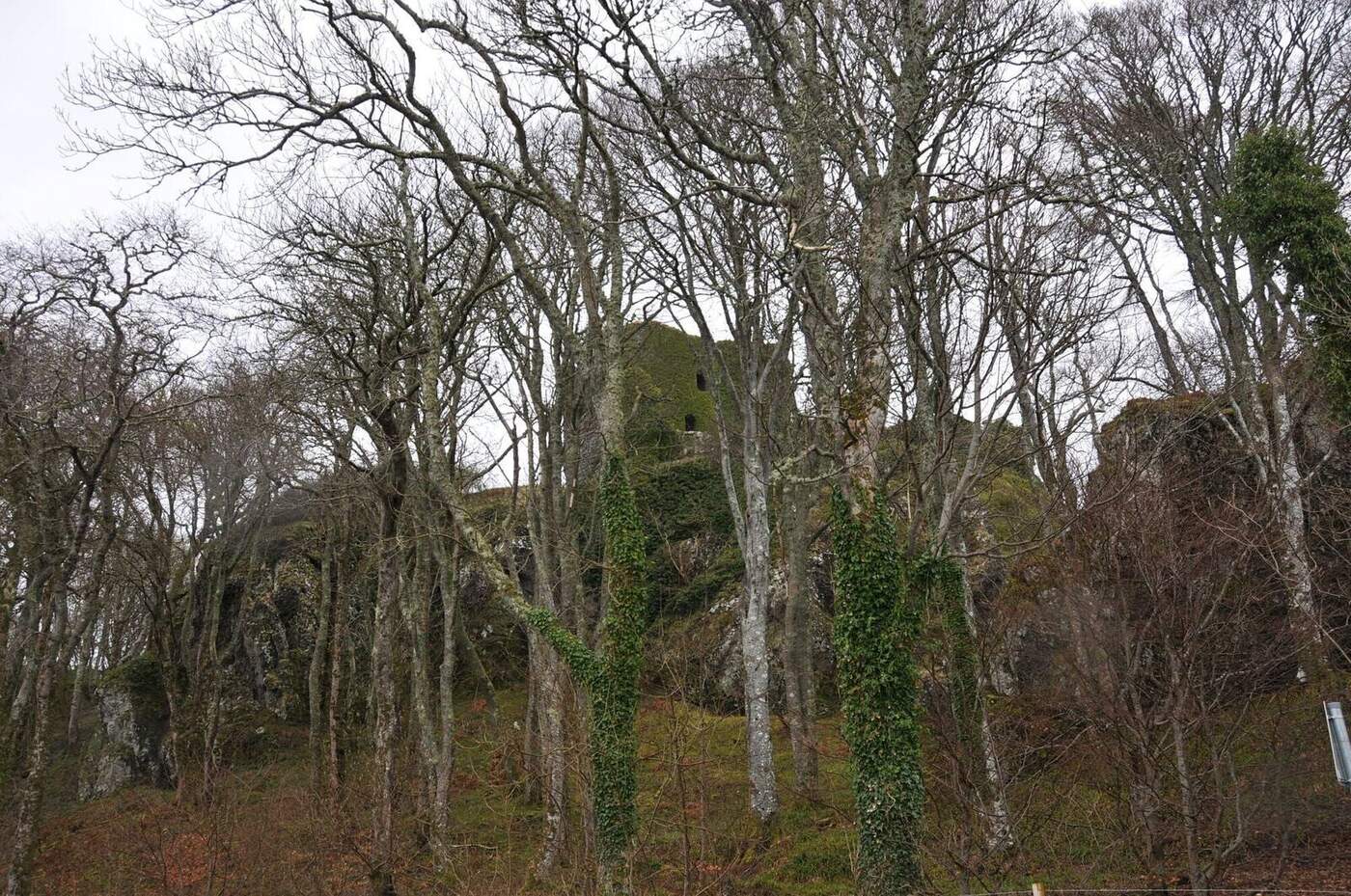
Scotland/Argyll & the Isles/Dunollie Castle
MACDOUGALL SEAT · OBAN
A cliff above Oban. A family story with a thousand years.
PLAN YOUR VISIT
Dunollie Museum, Castle & Grounds, Oban, PA34 5TT
VISIT TIME: 2–3 hoursPrices and season checked against Dunollie’s official FAQ; confirm current days and booking details before travel.
Dunollie’s official FAQ lists its main season from mid-March to the end of October, usually Tuesday–Sunday,10am–4pm.
Use the address and map link above for Dunollie Castle. Allow time for the final rural approach and check parking guidance before setting out.
The site has parking, café, shop, toilets, museum rooms and outdoor paths. The castle and woodland include slopes and uneven historic ground.
WHAT TO EXPECT
01 / THE STORY
Dunollie watches the northern entrance to Oban Bay from a rocky height. The view towards Kerrera explains why generations returned to this point long before the surviving stone tower appeared.
A museum and family collection below the ruin broaden the visit. Dunollie is a place where archaeology, MacDougall memory and everyday objects work better together than a single heroic clan tale.
The climb reveals sea routes, islands and the bay that made the headland valuable. The museum then brings the scale down from landscape to household objects and textiles.
Treat it as a small complete visit. A photograph from the tower misses the archive; a museum-only visit misses the geography.
Dun Ollaigh appears in early annals, and archaeology confirms occupation long before the visible tower house. Excavation in 1978 explored those earlier defences.
Most surviving masonry is fifteenth-century, with later work. An ancient place-name does not turn every standing wall into an early-medieval structure.
02 / VISUAL JOURNAL
Every photograph on this page was made by CastleScotland during personal field visits.
01 / THE STORY CONTINUES
The MacDougalls belonged to a western world linked by water. From the headland, boats approaching Oban Bay could be watched and movement along the coast understood.
Modern roads can make an island-facing castle seem remote. The view restores the sea as a route rather than an obstacle.
By the eighteenth century the principal residence shifted from the exposed castle to the house below, though sources differ over the exact timing.
The change preserved a relationship with the ancestral site while choosing greater comfort. Ruin and later home now tell that transition side by side.
03 / MOMENTS IN STONE
Dun Ollaigh appears in early annals. The headland is a direct reminder that power in Argyll travelled by water.
Most of the surviving stone castle is built. The museum turns family objects into another layer of the castle story.
Residence shifts downhill; sources differ on the precise transition. The approach lets the castle appear gradually above the bay.
Excavation investigates the earlier fortifications.
04 / FIND THE CASTLE
56.426556,-5.484559
Dunollie Castle is at Dunollie Museum, Castle & Grounds, Oban, PA34 5TT. Check current access arrangements before travelling.
Open mapDunollie’s official FAQ lists its main season from mid-March to the end of October, usually Tuesday–Sunday,10am–4pm.
Use the address and map link above for Dunollie Castle. Allow time for the final rural approach and check parking guidance before setting out.
For the classic view, work from the shore-side or approach path with Oban Bay behind. On a grey day, focus on textures in the ruin and woodland.
History and visitor advice: CastleScotland fieldwork and official operator sources.
Annals mention Dun Ollaigh in the late seventh and early eighth centuries. Excavations directed by Leslie Alcock in 1978 confirmed early medieval activity, including ramparts and evidence of metalworking. The Oxford and Edinburgh Atlas of Hillforts stresses an important limit: the existence of the early fortification is secure, but its full form and extent remain unknown. Later construction conceals parts of the earlier summit, so a complete reconstruction would go beyond the evidence.
Dunollie subsequently belonged to the MacDougall lordship of Lorn. The clan’s history connects it with the struggle against Robert the Bruce, but battles elsewhere should not be turned into undocumented sieges of this particular tower. The clan society describes John of Lorn’s defeat at the Pass of Brander in 1308. That regional conflict predates the principal standing fabric and helps explain changes in MacDougall power without dating the surviving castle to Bruce’s lifetime.
The tower and courtyard represent a later medieval household. HES describes four main storeys, with a vaulted cellar below the upper accommodation. A curtain wall enclosed the courtyard, where traces of further buildings survive. The tower stood in one corner rather than filling the entire summit. From outside, the relationship between tower, enclosure and steep ground is more informative than treating the ruin as a single freestanding block.
The move towards a more comfortable house below the castle belongs to the eighteenth century, but sources are not entirely consistent about the transition. HES places abandonment in the early eighteenth century, while the museum’s own account dates the laird’s house to 1746 and connects it with the family’s move downhill. Its familiar name, the 1745 House Museum, should not be silently substituted for that stated building date. The change was a sequence rather than one securely documented day of departure.
Inside the museum, domestic objects widen the story beyond chiefs and warfare. The collections include material assembled by Hope MacDougall, while family archives preserve records of land, marriage and political affairs. These sources deserve to be understood as evidence with their own dates and contexts. A household object can reveal work and daily life without needing to be connected to a famous monarch.
The Brooch of Lorn provides a good example of the boundary between an object and its traditional story. It is said to have been taken from Robert the Bruce at Dalrigh in 1306; the museum itself uses qualified language. Keep that association as tradition, not proven provenance. Dunollie is a scheduled monument, and the preservation trust cares for its buildings and collections. Allow time for both the headland and the museum: the strength of the visit lies in the conversation between landscape, archaeology and family memory.
08 / EXPLORE NEXT
Find Scottish castles by region, landscape or the stories that bring them to life.
 Argyll & the IslesCastle Stalker
  Argyll & the IslesAchallader Castle
  West LothianBlackness Castle