TICKETS£7.50
Prices checked on the official visitor page; confirm current access before travel.
 Beta
Beta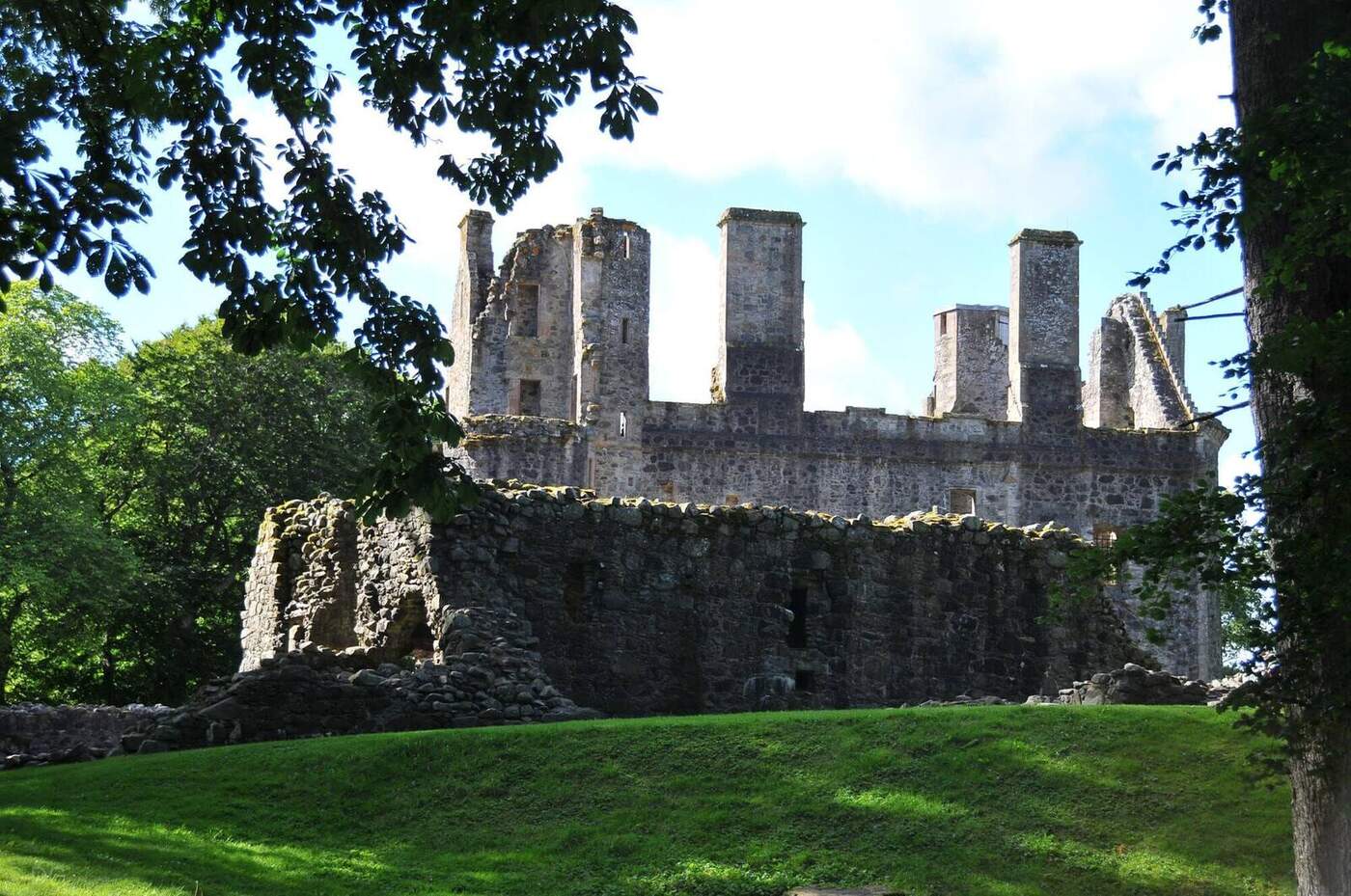
Scotland/Aberdeenshire/Huntly Castle
GORDON STRONGHOLD · STRATHBOGIE
A medieval tower. A Renaissance palace in ruin.
PLAN YOUR VISIT
Castle Avenue, Huntly, AB54 4SH
VISIT TIME: 1–1.5 hoursPrices checked on the official visitor page; confirm current access before travel.
Historic Environment Scotland lists seasonal paid admission. Check the live page for opening days and any restricted tower access.
Use the address and map link above for Huntly Castle. Allow time for the final rural approach and check parking guidance before setting out.
The ruin includes uneven ground and historic stairs. Temporary safety closures may affect individual sections.
WHAT TO EXPECT
01 / THE STORY
Huntly Castle is a family success story written in stone. Beneath the carved Renaissance palace lie the traces of an earlier motte, a medieval tower and centuries of Gordon ambition.
This is a ruin with more personality than a simple timeline suggests. Look for names, dates and heraldry across the façade: the owners wanted every arrival to know exactly who lived here.
The palace front is one of the most impressive pieces of carved architecture at any Scottish castle. Even without its roof, it still feels like a grand entrance rather than a defensive shell.
Allow time to look beyond the façade. The low remains of earlier buildings show that this was repeatedly rebuilt as the family's fortunes changed.
Around 1200, the lords of Strathbogie established a motte-and-bailey stronghold here. After David of Strathbogie opposed Robert the Bruce, the estate passed to Sir Adam Gordon.
The Gordons later built a substantial tower house. Much of it now survives only at foundation level, so the apparent gaps are part of the story rather than empty ground.
The place was long known as Strathbogie. In 1506, a royal charter authorised the name Huntly, reflecting the rise of the Gordon earls of Huntly.
The old name did not vanish overnight. Place names, like castles, can change slowly even when a powerful family wants to announce a new identity.
02 / VISUAL JOURNAL
Every photograph on this page was made by CastleScotland during personal field visits.
01 / THE STORY CONTINUES
George Gordon, fourth Earl of Huntly, transformed the residence in the mid-sixteenth century. The date 1553 and heraldry associated with George and his wife Elizabeth Keith make the stonework feel unusually personal.
A later rebuilding is tied to George Gordon, sixth Earl and first Marquess of Huntly, and Henrietta Stewart. Their names and the date 1602 appear high on the palace, turning the façade into a family statement visible across generations.
Huntly was burned in 1452 during James II's struggle with the Black Douglases. Conflict with Mary, Queen of Scots ended with the fourth earl's death in 1562 and the seizure of castle furnishings; James VI ordered further damage in 1594.
The Gordons rebuilt after repeated political shocks. Huntly's grandeur makes more sense when you see it as defiance as well as decoration.
03 / MOMENTS IN STONE
A motte-and-bailey stronghold develops at Strathbogie. The façade turns aristocratic power into architecture.
The Gordons acquire the lordship and later build an L-plan tower. The changing name follows the rise of the Gordon family.
A royal charter authorises the name Huntly. The castle’s history is inseparable from Scotland’s religious and political upheaval.
A major palace rebuilding creates much of the surviving upper frontage.
04 / FIND THE CASTLE
57.454705,-2.781929
Huntly Castle is at Castle Avenue, Huntly, AB54 4SH. Check current access arrangements before travelling.
Open mapHistoric Environment Scotland lists seasonal paid admission. Check the live page for opening days and any restricted tower access.
Use the address and map link above for Huntly Castle. Allow time for the final rural approach and check parking guidance before setting out.
Use the long palace front for scale, then move closer for the carved details and the relationship between the older tower and newer range.
History and visitor advice: CastleScotland fieldwork and official operator sources.
The earliest castle developed around 1200 as a motte and bailey, with timber structures on an earthwork mound and an adjoining enclosure. It served the lords of Strathbogie before the Gordons. Following David of Strathbogie’s change of allegiance in 1314, Robert the Bruce granted the lordship to Sir Adam Gordon. Later fourteenth-century Gordon building included a substantial L-plan tower house, now largely represented by foundations rather than the tall palace visible today.
Destruction and rebuilding repeatedly altered the residence. Archibald Douglas, Earl of Moray, burned the castle in 1452 during the struggle involving James II and the Black Douglases. A large hall and chamber block developed along the southern side in the later fifteenth century. The royal charter of 1506 authorised the name Huntly, although Strathbogie remained in use afterwards. A legal change of name did not instantly replace familiar local usage.
George Gordon, fourth Earl of Huntly, remodelled the palace in the mid-sixteenth century. The date 1553 and heraldic references to him and his wife, Elizabeth Keith, survive in its decoration. This powerful Catholic noble’s conflict with Mary, Queen of Scots ended with his death during the campaign of 1562 and the seizure of the castle’s furnishings. Religious allegiance mattered, but so did royal authority and the influence of competing noble families.
Another major rebuilding followed the damage ordered by James VI in 1594. George Gordon, sixth Earl and subsequently first Marquess of Huntly, and Henrietta Stewart are commemorated in the palace’s later display. Work dated 1602 is central to the appearance of the surviving upper frontage. Describing everything impressive here as sixteenth-century misses this important later contribution. Carved heraldry and formal rooms speak of dynastic identity as much as military strength.
Huntly remained involved in the conflicts of the seventeenth century, and further construction included defensive earthworks and changes around the courtyard. Its decline was gradual: an image from 1799 still shows the palace roofed while other parts were ruinous. State care began in 1924–25; HES’s summary and detailed chronology differ on the precise year. The castle is now a scheduled monument cared for by Historic Environment Scotland, with archaeology and exposed decorative fragments requiring continuing attention.
The surviving palace suggests hospitality, display and domestic hierarchy on an ambitious scale. Large windows, carved details and the contrast between upper rooms and service spaces reward close looking. Keep the sequence in mind: an earthwork stronghold, a Gordon tower, an expanding palace and finally a conserved ruin. That layered history is more revealing than treating Huntly as a single building created by one great earl.
08 / EXPLORE NEXT
Find Scottish castles by region, landscape or the stories that bring them to life.
 AberdeenshireKildrummy Castle
  AberdeenshireBraemar Castle
  AberdeenshireCrathes Castle