Edinburgh Castle
Explore Edinburgh Castle in Edinburgh and the Lothians, Scotland, with history, visitor context, photos and regional map links. Edinburgh Castle is one of Scotland’s most famous landmarks and one of the most historically important fortified sites in Europe.
Location
Open in Google Maps →Plan your visit
Explore
Article sections
Edinburgh Castle – A Fortress at the Heart of Scottish History
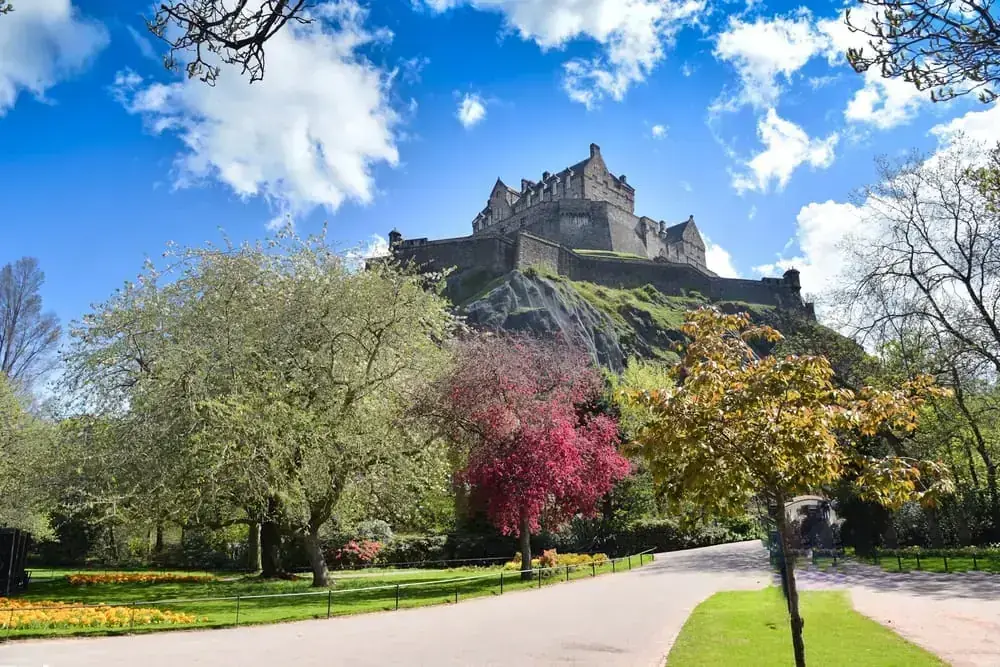
Edinburgh Castle is one of Scotland’s most famous landmarks and one of the most historically important fortified sites in Europe. Perched high above the capital on Castle Rock, an ancient volcanic outcrop, it dominates the Edinburgh skyline and offers commanding views across the city.
For centuries, the castle served as a royal residence, military fortress, government centre, prison and national symbol. Its walls witnessed wars, sieges, royal births and political struggles that helped shape the history of Scotland.
Early History of Castle Rock
Archaeological evidence shows that Castle Rock was occupied from at least the late Bronze Age. During the Iron Age, a fortified settlement stood on the summit, taking advantage of the rock’s naturally defensive position.
The stronghold is often associated with Din Eidyn, a fortress mentioned in early medieval traditions and poetry. Although the precise relationship between Din Eidyn and the later medieval castle remains the subject of historical interpretation, the site was clearly an important centre long before the surviving stone buildings were constructed.
Castle Rock should therefore be understood as an ancient fortified location rather than as a castle that has survived unchanged since prehistoric times.
The Medieval Royal Castle
Edinburgh Castle became an important royal centre during the reign of David I in the 12th century. Around 1130, David built St Margaret’s Chapel in memory of his mother, Queen Margaret, who was later canonised.
The chapel is the oldest surviving building in Edinburgh and one of the oldest surviving structures within any Scottish castle. Its small size and simple Romanesque architecture contrast with the massive defensive walls that surround it today.
During the Wars of Scottish Independence, Edinburgh Castle repeatedly changed hands between Scottish and English forces. In 1296, it was captured by Edward I of England.
In March 1314, Scottish soldiers led by Thomas Randolph, Earl of Moray, launched a daring night attack. They climbed the steep northern face of Castle Rock and recaptured the fortress from the English.
The operation took place several months before Robert the Bruce’s victory at the Battle of Bannockburn. After the castle was recovered, Bruce ordered much of its defences to be destroyed. This policy, known as slighting, was intended to prevent the English from using the fortress if they captured it again.
Royal Residence and Renaissance Palace
During the 15th and 16th centuries, Edinburgh Castle developed into an important royal residence and administrative centre. The Stewart monarchs transformed parts of the fortress into a palace suitable for royal ceremonies, banquets and government business.
The Great Hall was built for James IV and completed around 1511. Its most impressive feature is its magnificent hammerbeam roof, one of the finest surviving medieval timber roofs in Scotland. The hall was used for royal banquets and important state gatherings.
The Royal Palace occupies another side of Crown Square. On 19 June 1566, Mary, Queen of Scots, gave birth there to her son James VI.
James became King of Scotland while still an infant. In 1603, following the death of Elizabeth I, he also became James I of England and Ireland. This event created the Union of the Crowns, although Scotland and England remained separate kingdoms with separate parliaments until 1707.
The small room in which James was born can still be visited inside the palace.
The Lang Siege and the Half Moon Battery
One of the most destructive episodes in the castle’s history was the Lang Siege, which lasted from 1571 until 1573. Supporters of Mary, Queen of Scots, held the fortress against forces loyal to the young James VI.
Heavy artillery bombardment damaged much of the medieval castle, including David’s Tower. After the siege, the defences were rebuilt and strengthened.
The Half Moon Battery was constructed between 1573 and 1588 over the ruins of David’s Tower. Its curved stone walls remain one of the castle’s most recognisable architectural features.
Despite its impressive appearance, the battery was already somewhat outdated by the standards of late 16th-century artillery warfare. Nevertheless, it became a powerful visual symbol of the fortress.
Military Fortress and Prison
From the late 16th century onwards, Edinburgh Castle became increasingly important as a military garrison rather than a permanent royal residence.
In 1650, the castle was captured by the forces of Oliver Cromwell following a siege. During the following decades, many of its royal buildings were adapted for military use.
The castle also served as a prison, particularly for prisoners of war. Soldiers and sailors captured during conflicts with France, Spain, the Netherlands and the American colonies were held within its walls.
Graffiti carved by prisoners can still be seen in parts of the prison buildings, providing a personal record of those who were confined there.
The Jacobite Risings
During the Jacobite risings of 1715 and 1745, Edinburgh Castle remained in the hands of government forces loyal to the established British state.
In 1745, the Jacobite army led by Charles Edward Stuart, better known as Bonnie Prince Charlie, captured much of Edinburgh. However, it failed to take the castle.
The government garrison continued to hold the fortress and fired on Jacobite positions in the city. The castle therefore acted as a government stronghold against the Jacobite rebellion, not against royalists in the general sense.
Important Buildings and Monuments
The architecture of Edinburgh Castle reflects many different periods of Scottish history.
St Margaret’s Chapel
Built around 1130 by David I, St Margaret’s Chapel is the oldest surviving building in Edinburgh. It was dedicated to David’s mother, Saint Margaret of Scotland.
The Great Hall
Completed around 1511 for James IV, the Great Hall was used for royal ceremonies and banquets. Today, it contains displays of historic weapons and armour.
The Royal Palace
The Royal Palace contains the Crown Room and the small chamber where James VI was born in 1566.
Half Moon Battery
Built after the Lang Siege, the Half Moon Battery stands over the remains of the medieval David’s Tower.
Scottish National War Memorial
The Scottish National War Memorial was officially opened in 1927. It commemorates members of the Scottish armed forces and Scots serving in other units who died in the First World War, Second World War and later conflicts.
The Honours of Scotland
Edinburgh Castle is home to the Honours of Scotland, which consist of the Crown, the Sceptre and the Sword of State.
They are the oldest surviving crown jewels in Britain and were first used together during the coronation of Mary, Queen of Scots, in 1543.
After the Act of Union in 1707, the Honours were locked away inside the castle. They were rediscovered in 1818 during a search led by Sir Walter Scott.
The Honours remain among the most important historic objects associated with the Scottish monarchy.
The Stone of Destiny
For many years, the Stone of Destiny, also known as the Stone of Scone, was displayed beside the Honours of Scotland at Edinburgh Castle.
The stone was historically associated with the inauguration of Scottish monarchs. It was taken to England by Edward I in 1296 and returned to Scotland in 1996.
However, the original text is now outdated. In March 2024, the Stone of Destiny was moved from Edinburgh Castle to Perth Museum, where it is currently displayed. It may still be temporarily removed for future coronations.
Visitors to Edinburgh Castle can therefore see the Honours of Scotland, but the Stone of Destiny is no longer part of the castle’s permanent exhibition.
Mons Meg
Mons Meg is one of the largest medieval siege cannons in Europe. The enormous bombard was manufactured in the 15th century and presented to James II of Scotland in 1457.
The cannon could fire massive stone balls, but its enormous weight made it difficult to transport. It was used both in warfare and during ceremonial celebrations.
Mons Meg was later taken to the Tower of London, but it returned to Edinburgh Castle in 1829. Today, it stands near St Margaret’s Chapel.
The One o’Clock Gun
The One o’Clock Gun is one of Edinburgh Castle’s best-known traditions. It was first fired on 7 June 1861 as an audible time signal for ships in the Firth of Forth.
Sailors needed accurate timekeeping to calculate their position at sea. The gun complemented the visual time ball on the Nelson Monument on Calton Hill, which could be difficult to see during poor weather.
The gun is normally fired at 1pm every day except Sundays, Good Friday and Christmas Day.
It is important to note that there is no attraction called the “Bell of the One O’Clock Gun”. The tradition involves the firing of a cannon rather than a bell.
Edinburgh Castle Today
Today, Edinburgh Castle is managed by Historic Environment Scotland and remains one of the most visited paid attractions in Scotland. More than two million visits were recorded in 2025.
The castle continues to have ceremonial and military functions. Gun salutes are fired on important national and royal occasions, and the site remains closely connected with the British Army.
Every August, the castle esplanade hosts the Royal Edinburgh Military Tattoo. This internationally recognised event features military bands, pipers, drummers and performers from around the world, with the illuminated castle forming a dramatic backdrop.
A Symbol of Scotland
Edinburgh Castle is more than a collection of historic buildings. It is a place where Scotland’s royal, military and political history can be explored within a single fortress.
Its story stretches from prehistoric settlement and medieval warfare to royal ceremonies, military traditions and modern tourism.
Standing above the centre of Edinburgh, the castle remains one of the most powerful and recognisable symbols of Scotland. Its dramatic location, complex architecture and connection with some of the most important events in Scottish history make it one of the country’s most fascinating historic sites.


No photos found in this article.