TICKETS£4.50
Reduced admission currently listed by Historic Environment Scotland because of access restrictions. Confirm the live visitor page before setting out.
 Beta
Beta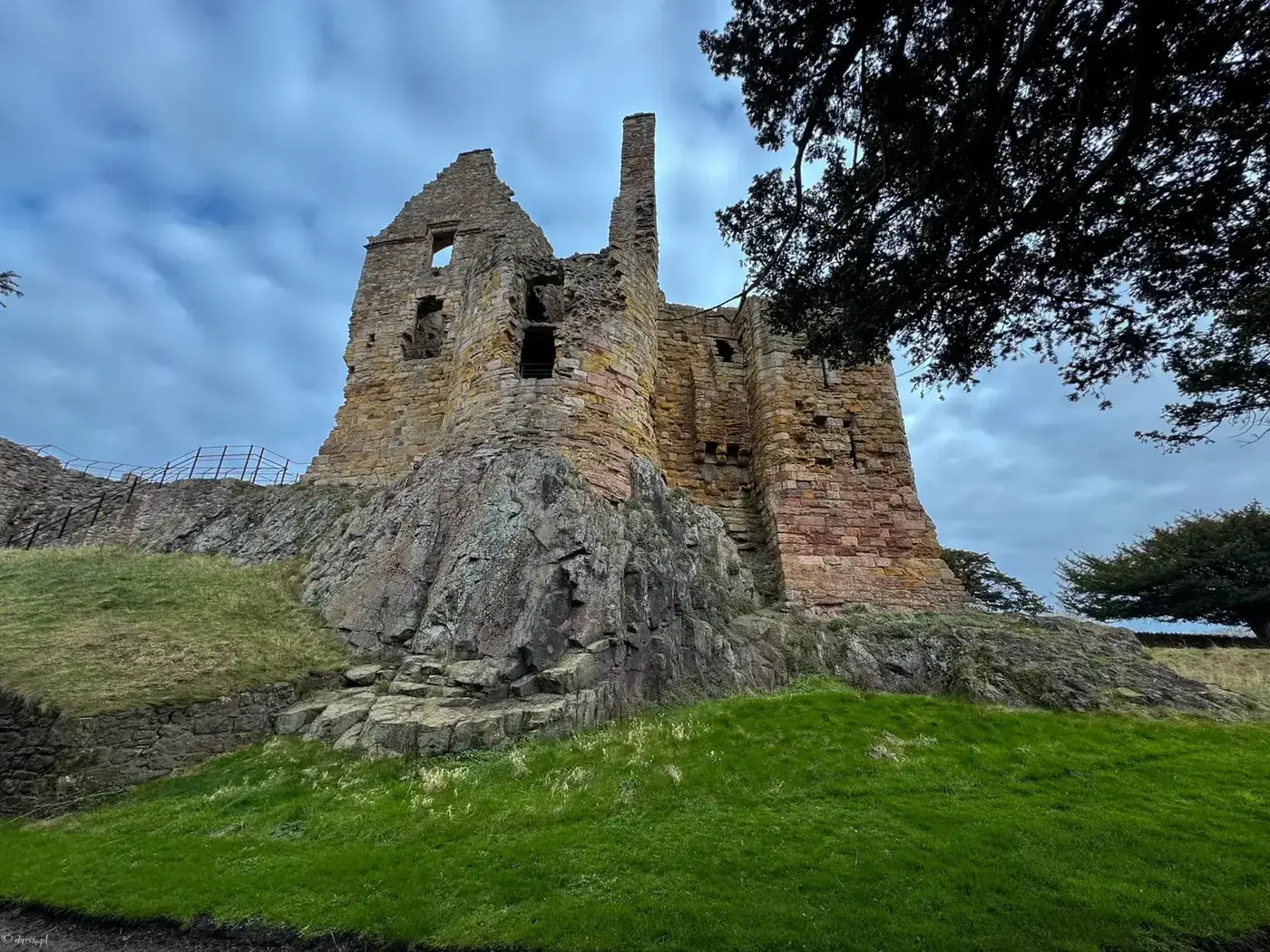
Scotland/East Lothian/Dirleton Castle
GARDENS & GUNS · EAST LOTHIAN
A medieval stronghold. Softened by extraordinary gardens.
PLAN YOUR VISIT
Dirleton, North Berwick, EH39 5ER
VISIT TIME: 1.5–2 hoursReduced admission currently listed by Historic Environment Scotland because of access restrictions. Confirm the live visitor page before setting out.
Opening arrangements, admission and access can change. Check the official visitor source before you travel.
Dirleton Castle rewards a little time outdoors. Plan for the final approach as part of the visit.
Historic ground can include uneven paths, steps and exposed conditions. Wear suitable footwear.
WHAT TO EXPECT
01 / THE STORY
Dirleton gives you a village green, a garden and then an unexpectedly substantial castle. Rounded towers rise from the rock behind the flowers, as though the fortress has settled into a quieter retirement.
Look a little closer and the peaceful setting begins to hide a busier world: sieges, great households and even a purpose-built home for the birds that helped feed them.
The combination is the attraction. You can enjoy the ruin’s solid stonework and then step back into planted spaces where the mood changes completely.
This is an appealing stop on an East Lothian outing if you like castles but do not want every visit to feel like another lesson in warfare. Give the gardens as much attention as the towers.
The de Vaux family built the medieval stronghold in the thirteenth century. Its rounded towers still give Dirleton a powerful outline, even with the later rooms open to the sky.
Begin by finding that older core. Then notice how other spaces gather around it. The castle grew as different households adapted what they had inherited, rather than starting again on an empty site.
Dirleton was captured in 1298 during Edward I’s campaign and changed hands during the wars that followed. Much later, Cromwell’s forces attacked in 1650.
You do not need the full sequence of owners to understand the result. The broken walls record a place that had to survive repeated interruptions before it could become the picturesque ruin seen today.
02 / VISUAL JOURNAL
Every photograph on this page was made by CastleScotland during personal field visits.
10 of 16 photographs
01 / THE STORY CONTINUES
Do not overlook the circular doocot: a pigeon house built to support the estate household. Pigeons were a source of food, so this attractive little building had a practical place in castle life.
Think of it as part of the kitchen story rather than a garden ornament. A grand residence needed a dependable supply of meals as much as it needed impressive rooms.
In later centuries, the ruined castle became something to admire within landscaped grounds. Its broken silhouette gained a new role: a dramatic backdrop instead of a defensive front line.
That is the pleasure of Dirleton today. Take a broad view with planting in the foreground, then move closer to the texture of the stone. The two experiences belong together.
Conservation work can affect access to historic interiors. Check the official notice before setting out, particularly if exploring rooms is the main reason for your trip.
Even on a garden-focused visit, wear shoes suited to uneven surfaces. Allow yourself a pause on the village side afterwards; Dirleton works well as part of an unhurried day rather than a dash between attractions.
03 / MOMENTS IN STONE
The de Vaux family develops the principal surviving stone castle. The formal garden gives Dirleton a distinctive, almost theatrical finish.
Dirleton passes to the Ruthvens through marriage; HES dates the marriage to around 1515. Different families changed the castle to suit new ideas of status and comfort.
English troops under George Monck besiege and capture the castle. Loss of roofs reveals the scale and relationships of the rooms.
04 / FIND THE CASTLE
56.046500,-2.775500
Dirleton Castle is at Dirleton, North Berwick, EH39 5ER. Check current access arrangements before travelling.
Open mapOpening arrangements, admission and access can change. Check the official visitor source before you travel.
Dirleton Castle rewards a little time outdoors. Plan for the final approach as part of the visit.
Walk the perimeter before choosing a viewpoint; the setting often tells as much of the story as the masonry.
History and visitor advice: CastleScotland fieldwork and official operator sources.
The substantial rounded towers at the south-west corner belong to this early stronghold. Their scale expresses the resources of a lordly household as well as the demands of defence. Walking around the ruin, compare their curved masonry with the later, more angular ranges. The contrast helps explain how successive owners adapted an existing residence instead of clearing the site and starting again.
Dirleton became involved in the Wars of Independence. In 1298 an English force commanded by Antony Bek, bishop of Durham, captured it during Edward I's Scottish campaign. Further fighting followed, and the castle was partly dismantled in the early fourteenth century under Robert Bruce's policy of denying strongholds to his opponents. These episodes should not be compressed into a single siege or attributed to Edward personally directing every assault.
Through marriage, the estate passed to the Haliburtons in the fourteenth century. Their substantial rebuilding included the gatehouse and accommodation along the eastern side. Here the story moves beyond military recovery: a great hall, service accommodation and controlled approaches supported the routines of an important household. What survives is evidence of residence, hospitality and administration alongside the protection offered by walls and gates.
The Ruthvens followed in the early sixteenth century through the marriage of Janet Haliburton and William Ruthven. HES places that marriage around 1515, so an exact transfer date of 1513 is misleading. Their additions included more comfortable lodgings, while the dovecot and evidence of garden-making reveal ambitions extending beyond the castle rooms. Archaeological work has identified traces interpreted as sixteenth-century garden features, but today's planting is not a complete reconstruction of them.
In 1650, after the battle of Dunbar, English troops under George Monck besieged and captured Dirleton. Its subsequent ruinous state reflects that attack and the end of its principal residential role, followed by a much longer history of loss. The Nisbet family bought the estate in 1663 and developed their home at nearby Archerfield rather than restoring Dirleton as their main residence.
Later owners made the ruins part of a designed landscape. Much of the garden character encountered today belongs to nineteenth-century and subsequent work, giving the site another history worth noticing in its own right. The castle entered state guardianship in 1924 and is protected as scheduled monument SM90096. HES's assessment distinguishes its care from the property's ownership; guardianship should not be described as an automatic state purchase.
Begin with the relationship between the garden and the elevated stone enclosure, then follow the different building ranges where access permits. The exposed rooms make the development unusually legible, while the planting provides a gentler final impression. Dirleton's appeal is this coexistence of a fortified medieval household, later domestic ambition and carefully composed landscape, each contributing something different to the visit.
Compare this stop with the best castles in and near Edinburgh, including city landmarks and coastal day trips. Use our Scotland castles map to check locations before choosing your route.
08 / EXPLORE NEXT
Find Scottish castles by region, landscape or the stories that bring them to life.
 Edinburgh & The LothiansSaltcoats Castle
  The HighlandsSinclair Girnigoe Castle
  The HighlandsCaisteal Maol