TICKETSNo standard ticket; view from permitted outdoor routes.
Visitor conditions are stated conservatively from current official or local guidance; always confirm before travel.
 Beta
Beta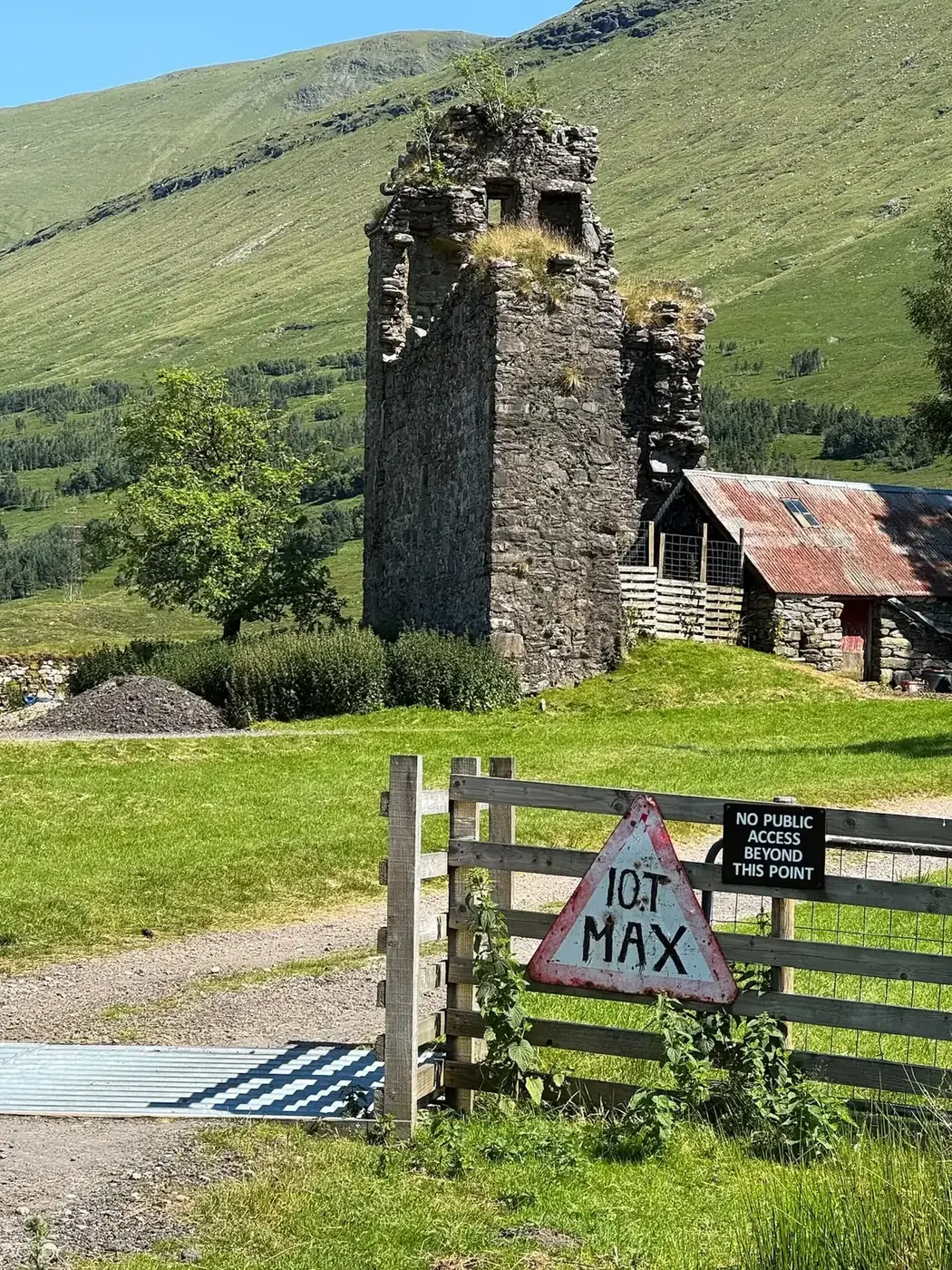
Scotland/Argyll & the Isles/Achallader Castle
FIELD GUIDE · ARGYLL & THE ISLES
A Scottish castle story. Read through its landscape.
PLAN YOUR VISIT
Glen Orchy, near Bridge of Orchy, PA36 4AD
VISIT TIME: 30–60 minutesVisitor conditions are stated conservatively from current official or local guidance; always confirm before travel.
No standard ticket; view from permitted outdoor routes.
Use the address and map link above for Achallader Castle. Allow time for the final rural approach and check parking guidance before setting out.
Rural ground can be wet and the ruin is not a managed interior attraction.
WHAT TO EXPECT
01 / THE STORY
Achallader is a modest ruin in a very large landscape. Near Bridge of Orchy, the remaining tower rises beside a burial ground while the hills of Glen Orchy take over the horizon.
Its building date is less certain than many summaries suggest. The best story joins an early seventeenth-century tower, Campbell power and a meeting of Highland chiefs on the eve of a dangerous political change.
This is a quiet exterior stop rather than a restored attraction. The surviving height and openings are easiest to understand when the tower is photographed with the glen around it.
Respect the burial ground, boundaries and unstable masonry. Empty ground around a small ruin can preserve archaeological evidence too.
Historic Environment Scotland assigns the standing tower to the early seventeenth century. Earlier occupation and Fletcher traditions belong to the place, but do not securely date these particular walls.
The Campbell association is strong, yet it cannot identify who laid every foundation. A family could acquire, use and rebuild a site at different times.
02 / VISUAL JOURNAL
Every photograph on this page was made by CastleScotland during personal field visits.
01 / THE STORY CONTINUES
The national record connects Achallader with the Campbells of Glenorchy and describes it as a hunting seat associated with Duncan, the seventh laird.
That use gives the compact residence a purpose within a far wider estate. The surrounding ground was part of its function, not empty scenery.
Achallader is associated with a meeting of Highland chiefs in 1691, when loyalties and oaths to William and Mary carried serious consequences.
The documented connection places this small ruin inside national politics. It does not give us the exact speeches spoken here, so those tempting dramatic scenes remain unwritten.
03 / MOMENTS IN STONE
HES dates the surviving tower to this period; earlier associations remain distinct. Glen Orchy near Bridge of Orchy is essential to the way this castle is understood.
A meeting of Highland chiefs is associated with Achallader. HES dates the surviving tower to this period; earlier associations remain distinct.
The castle and burial ground are protected as SM4136. Current access is part of the guide: check the official or local notice before making the final approach.
04 / FIND THE CASTLE
56.560223,-4.731874
Achallader Castle is at Glen Orchy, near Bridge of Orchy, PA36 4AD. Check current access arrangements before travelling.
Open mapNo standard ticket; view from permitted outdoor routes.
Use the address and map link above for Achallader Castle. Allow time for the final rural approach and check parking guidance before setting out.
Photograph Achallader Castle as part of its setting. A wide view is often more truthful than a close crop, and all original masonry should be observed without climbing or crossing boundaries.
History and visitor advice: CastleScotland fieldwork and official operator sources.
The Campbell association is nevertheless important. The HES record connects Achallader with the Campbells of Glenorchy and describes it as a hunting seat associated with Duncan, the seventh laird. That should not be expanded into certainty about who laid every foundation. A family’s use of a property, its acquisition and its surviving building phases need not coincide. Keeping those questions separate allows the castle to retain its Highland context without giving an uncertain construction history a false precision.
Look at the remaining rubble masonry and the vertical arrangement of the openings. They suggest the compact organisation of a tower residence rather than a sprawling courtyard palace. The stair position and defensive openings are useful features to identify from a permitted viewpoint. Avoid assigning every broken edge to a known attack. A ruined wall records loss, but its present shape does not by itself date that loss or identify the people responsible for it.
Achallader also belongs to the political history of the late seventeenth century. The Argyll Museums Forum identifies it with a meeting of Highland chiefs in 1691. This provides a firmer reason to discuss the place in the context of Jacobite-era negotiations than a vague claim that every wall witnessed clan warfare. The meeting should not be turned into a detailed account of speeches or promises without consulting documentary evidence. A brief, qualified connection is more useful than an embellished scene.
Local stories can add another layer, but they need to remain stories. Accounts connecting Black Duncan and the Fletchers with the acquisition of land belong to a tradition that should not substitute for a charter or building record. This guide does not use a colourful tale to decide the tower’s date. The distinction leaves space for local memory while protecting the historical outline. A compelling tradition can be interesting precisely because of what it reveals about later ways of remembering power.
The castle and its burial ground are protected as scheduled monument SM4136. An older listed-building record was removed to avoid overlapping designations; that does not mean the site lost its archaeological protection. The ground around a ruin can matter as much as the visible masonry. Treat boundaries and local access information seriously, and do not enter unstable remains. A respectful exterior visit can still reveal the tower’s scale and its relationship with the wider glen.
For photography, try a broad view first, allowing the hills and nearby ground to establish the setting. Follow with details that show the remaining height and stonework. The useful story is not a confidently dated single act of construction followed by a single dramatic destruction. It is a place with layered associations, an incompletely resolved building history and a later political connection. Achallader rewards that patient approach: its uncertainties are part of understanding the site, not a reason to invent the missing chapters.
08 / EXPLORE NEXT
Find Scottish castles by region, landscape or the stories that bring them to life.
 Argyll & the IslesDunollie Castle
  Argyll & the IslesCastle Stalker
  Stirling & Forth ValleyStirling Castle