TICKETSFree entry; check the official page for current opening conditions.
Visitor conditions are stated conservatively from current official or local guidance; always confirm before travel.
 Beta
Beta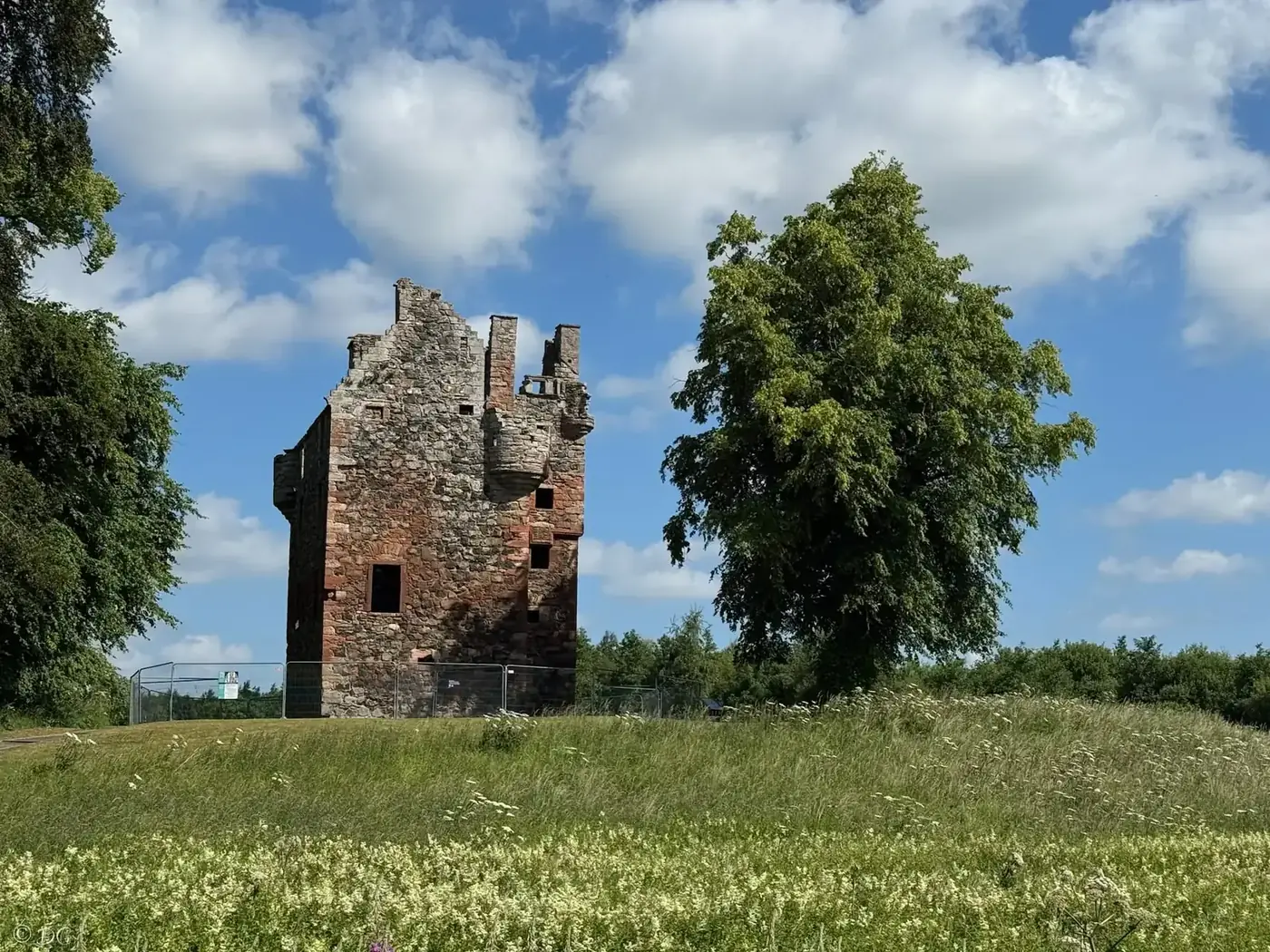
Scotland/Scottish Borders/Greenknowe Tower
FIELD GUIDE · SCOTTISH BORDERS
A Scottish castle story. Read through its landscape.
PLAN YOUR VISIT
Near Gordon, Scottish Borders, TD3 6JL
VISIT TIME: 30–45 minutesVisitor conditions are stated conservatively from current official or local guidance; always confirm before travel.
Free entry; check the official page for current opening conditions.
Use the address and map link above for Greenknowe Tower. Allow time for the final rural approach and check parking guidance before setting out.
Historic stairs and uneven surfaces limit step-free access.
WHAT TO EXPECT
01 / THE STORY
Greenknowe Tower is small enough to understand in a single circuit and distinctive enough to remember. Its tall L-shaped form rises beside the road near Gordon, softened by rounded turrets and carved details.
A date above the door introduces James Seton and Janet Edmonstone. The stonework then complicates the story: their work probably remodelled an older tower rather than beginning on an empty site.
This is an excellent place to learn how a tower house worked without facing a sprawling ruin. The vaulted basement, winding stair and rooms stacked above one another fit into a compact plan.
Check the current official access notice before travelling. Even when the interior is unavailable, the exterior gives a clear reading of the building's shape.
The entrance bears the date 1581 with the initials of James Seton and his wife Janet Edmonstone. It gives the building campaign a rare human signature.
Differences in masonry led Historic Environment Scotland to interpret that campaign as a remodelling of something older. A carved date can anchor a chapter without dating every wall.
02 / VISUAL JOURNAL
Every photograph on this page was made by CastleScotland during personal field visits.
10 of 15 photographs
01 / THE STORY CONTINUES
Round corner turrets and decorative details gave the residence more personality than a plain defensive block. Protection mattered, but so did the impression made on visitors.
Look up after studying the entrance. The upper outline is where a practical Borders home becomes an architectural statement.
In the seventeenth century the tower belonged to the Pringles. Walter Pringle became associated with the Covenanter cause during a period of religious and political conflict.
That link brings national tension into a very compact house. By 1830 the tower was derelict, leaving conservation to secure the remarkably legible shell seen today.
03 / MOMENTS IN STONE
The dated doorway records Seton and Edmonstone; the work probably remodelled an older tower. near Gordon in the Scottish Borders is essential to the way this castle is understood.
The Pringles own the house; Walter Pringle is associated with the Covenanters. The dated doorway records Seton and Edmonstone; the work probably remodelled an older tower.
The tower is derelict. Current access is part of the guide: check the official or local notice before making the final approach.
04 / FIND THE CASTLE
55.677743,-2.574693
Greenknowe Tower is at Near Gordon, Scottish Borders, TD3 6JL. Check current access arrangements before travelling.
Open mapFree entry; check the official page for current opening conditions.
Use the address and map link above for Greenknowe Tower. Allow time for the final rural approach and check parking guidance before setting out.
Photograph Greenknowe Tower as part of its setting. A wide view is often more truthful than a close crop, and all original masonry should be observed without climbing or crossing boundaries.
History and visitor advice: CastleScotland fieldwork and official operator sources.
That distinction gives visitors something specific to look for. Compare the masonry before deciding that the tower belongs to a single moment. Different phases can coexist within an apparently unified shape. A later owner might make an inherited building more comfortable or more expressive of status while retaining substantial earlier work. This is an interpretation of the architectural evidence, not a licence to assign unrecorded dates to individual stones. The word ‘probably’ is useful here because the evidence does not settle every stage.
The surviving iron yett at the entrance makes the protective side of the house tangible. Decorative turrets create a different impression higher up. Looking from one to the other helps avoid the assumption that every feature served the same purpose. A tower residence could control entry while presenting a more elaborate outline to the world outside. The contrast is a rewarding photographic subject: doorway, wall and skyline offer different ways of understanding one compact household setting.
The Pringles acquired Greenknowe in the early seventeenth century. Walter Pringle, a Covenanter, belongs to its later story in the middle of that century. HES uses his recollections when discussing the house and grounds, but some proposed alterations remain interpretations rather than securely dated building campaigns. The political connection should be retained without inventing a siege or turning the residence into the setting of every event in its owner’s life. A person’s association with a house is not evidence that all their activities occurred there.
By 1830 the tower was derelict. That provides a useful later boundary without pretending that a single documented disaster explains every missing floor or roof timber. Ruin can result from a sequence of changes in use and maintenance. The substantial standing walls retain more architectural coherence than the word ‘fragments’ suggests. Greenknowe is a roofless building whose overall form remains readable, and the distinction matters when setting expectations for a visit or comparing it with more fragmentary sites.
Spend time looking at the relationship between the entrance, the main block and the projecting wing. An exterior circuit, where permitted, can communicate more than one frontal photograph. A wide view captures the tower’s small scale; closer details reveal the choices that gave it character. There is no need to reconstruct lost furniture or populate each opening with an imagined defender. The surviving building already offers enough evidence for a careful account of a fortified home and its later adaptation.
Before travelling, check the official page for current access arrangements. Historic character does not guarantee that every stair or internal area is available. Keep the dated entrance, the probable older fabric and the later Pringle household together in mind. Greenknowe’s appeal comes from that layered picture: a residence that can look simple from a distance, yet rewards closer attention to evidence, uncertainty and the balance between protection and display.
08 / EXPLORE NEXT
Find Scottish castles by region, landscape or the stories that bring them to life.
 Scottish BordersNewark Tower
  Scottish BordersFatlips Castle
  Edinburgh & The LothiansDunbar Castle