TICKETSOpening and admission depend on the Bowhill Estate’s current programme; check before travel.
Visitor conditions are stated conservatively from current official or local guidance; always confirm before travel.
 Beta
Beta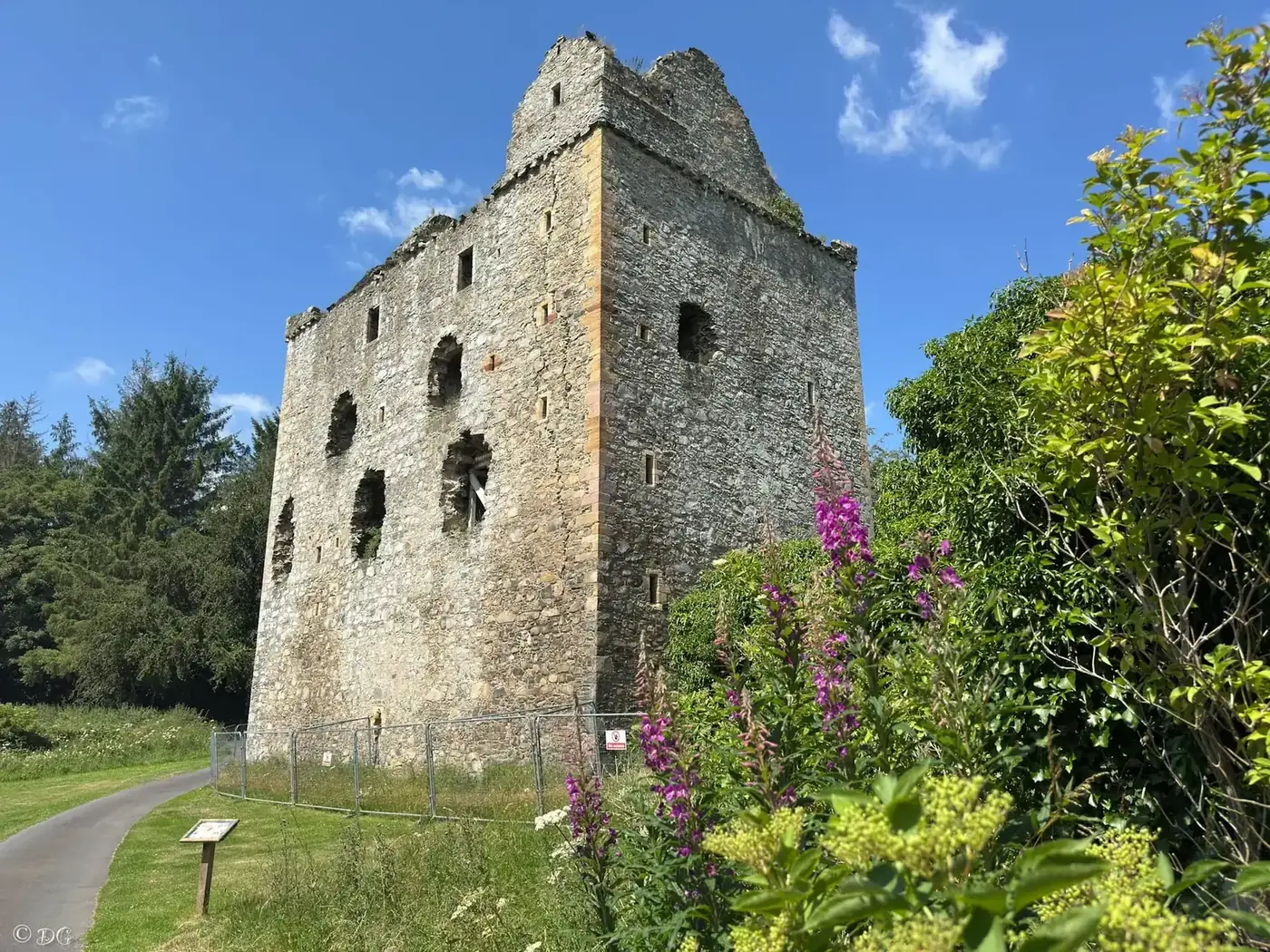
Scotland/Scottish Borders/Newark Tower
FIELD GUIDE · SCOTTISH BORDERS
Above the Yarrow. History, memory and Walter Scott.
PLAN YOUR VISIT
Bowhill Estate, near Selkirk, TD7 5ET
VISIT TIME: 30–60 minutesVisitor conditions are stated conservatively from current official or local guidance; always confirm before travel.
Opening and admission depend on the Bowhill Estate’s current programme; check before travel.
Use the address and map link above for Newark Tower. Allow time for the final rural approach and check parking guidance before setting out.
Access is estate-managed and historic stairs are part of any interior visit.
WHAT TO EXPECT
01 / THE STORY
Newark Tower stands above the Yarrow Water on the Bowhill estate, its dark outline carrying history, tragedy and poetry in almost equal measure. This is the Borders Newark—not the castle at Port Glasgow.
The tower's precise date is debated. Its strongest story does not depend on choosing one year: royal estates, the aftermath of Philiphaugh and Walter Scott all meet here.
The approach through the Bowhill landscape lets the tower appear in relation to the Yarrow valley. It is a far better introduction than isolating the masonry in a close photograph.
Follow the estate's current access arrangements. The ruin is part of a managed landscape rather than a freely open, staffed castle interior.
Bowhill's walking material gives 1423, while Historic Environment Scotland places major construction around 1465–68 and into the 1490s, replacing an older castle.
The honest description is a fifteenth-century tower with a disputed construction sequence. The disagreement need not be forced into a false exact date.
After the 1645 Battle of Philiphaugh, Royalist prisoners and people travelling with the army were killed. Later accounts connect captives and deaths with Newark and nearby Slain Men's Lea.
The atrocity is historical; precise numbers and the exact sequence at the castle vary between sources. That distinction matters when telling a painful story.
02 / VISUAL JOURNAL
Every photograph on this page was made by CastleScotland during personal field visits.
01 / THE STORY CONTINUES
Tradition says cries can be heard around Newark. The haunting belongs to later folklore and cannot prove where or how the killings took place.
Told carefully, the ghost story shows how violence remained in local memory without being used as historical evidence.
Newark provides the setting for the framing story of Walter Scott's The Lay of the Last Minstrel. Literature helped carry the tower into a wider romantic image of the Borders.
The poem is an imaginative afterlife, not an eyewitness record. Read a few lines before the walk and the landscape gains another layer.
03 / MOMENTS IN STONE
The origin is medieval, but the precise dating of the surviving tower is disputed. This Newark stands on the Bowhill estate, above the Yarrow Water.
The aftermath of Philiphaugh becomes associated with Newark; details of the killings vary between accounts. Ghost stories belong to later tradition, not proof of the events after Philiphaugh.
Walter Scott uses Newark for the framing narrative of The Lay of the Last Minstrel. The tower’s poetic setting is distinct from documentary history.
04 / FIND THE CASTLE
55.554777,-2.919726
Newark Tower is at Bowhill Estate, near Selkirk, TD7 5ET. Check current access arrangements before travelling.
Open mapOpening and admission depend on the Bowhill Estate’s current programme; check before travel.
Use the address and map link above for Newark Tower. Allow time for the final rural approach and check parking guidance before setting out.
Photograph Newark Tower as part of its setting. A wide view is often more truthful than a close crop, and all original masonry should be observed without climbing or crossing boundaries.
History and visitor advice: CastleScotland fieldwork and official operator sources.
Its connection with the Crown and the royal hunting landscape helps explain why this residence mattered beyond a single family. Historical Ettrick Forest was a territory with particular rights and administration, not simply a description of uninterrupted woodland. Looking across today's estate, resist the temptation to imagine every plantation, path and open view as an unchanged survival of the medieval hunting grounds.
The tower's thick walls give it a concentrated, defensive character, while its surviving openings indicate a home organised across several levels. Later details changed the building's appearance and arrangements. From outside, compare the main block with the smaller features around its upper outline. The result is more complex than a plain defensive shell, but the ruin should not be presented as a set of complete furnished rooms awaiting exploration.
Royal connections also require precise language. Accounts record the property being granted to Margaret of Denmark, James III's queen, and later to Margaret Tudor, queen of James IV. A grant or estate interest is not, by itself, evidence of a visit. The castle's political importance can be explained without adding an itinerary of monarchs whose presence in these particular rooms has not been established.
The darkest association concerns the aftermath of Philiphaugh, fought on 13 September 1645. David Leslie's Covenanter army defeated Montrose's Royalists nearby. HES records the killing of prisoners and camp followers, and notes secondary accounts linking captives with Newark before deaths at Slain Men's Lea. Other retellings place killings in the castle enclosure. The atrocity should be acknowledged, while the exact number of victims and precise sequence at Newark remain less secure.
Stories of cries heard near the castle belong to local ghost tradition, not evidence establishing what happened in 1645. Keeping that distinction preserves the later memory of the place without using a haunting to authenticate a historical event. It is possible to take the suffering associated with the campaign seriously while recognising that subsequent storytelling has added its own atmosphere to the ruins.
Newark also belongs to the literary landscape of Walter Scott: the castle provides the setting for the framing narrative of The Lay of the Last Minstrel. That imaginative role is a separate chapter from its medieval construction or civil-war associations. Fiction has helped shape how readers picture the Borders, but a poetic scene should not be silently converted into an eyewitness account of life inside the tower.
The ruin is protected as scheduled monument SM1729, and Bowhill identifies its conservation among the estate's heritage responsibilities. Plan around the estate's current access arrangements and enjoy the relationship between river, tower and wider grounds from permitted routes. Newark's strongest story is not a catalogue of supposedly certain royal visits. It is the meeting of a substantial medieval residence, a landscape altered by later owners, a painful military memory and an enduring literary imagination.
08 / EXPLORE NEXT
Find Scottish castles by region, landscape or the stories that bring them to life.
 Scottish BordersGreenknowe Tower
  Scottish BordersFatlips Castle
  The HighlandsDuntulm Castle