TICKETSExterior viewing is free
Selected guided tours: £11 adult, £9 concession and £6.50 child. Advance booking is required.
View current prices
Adult£11.00
Concession£9.00
Child£6.50
 Beta
Beta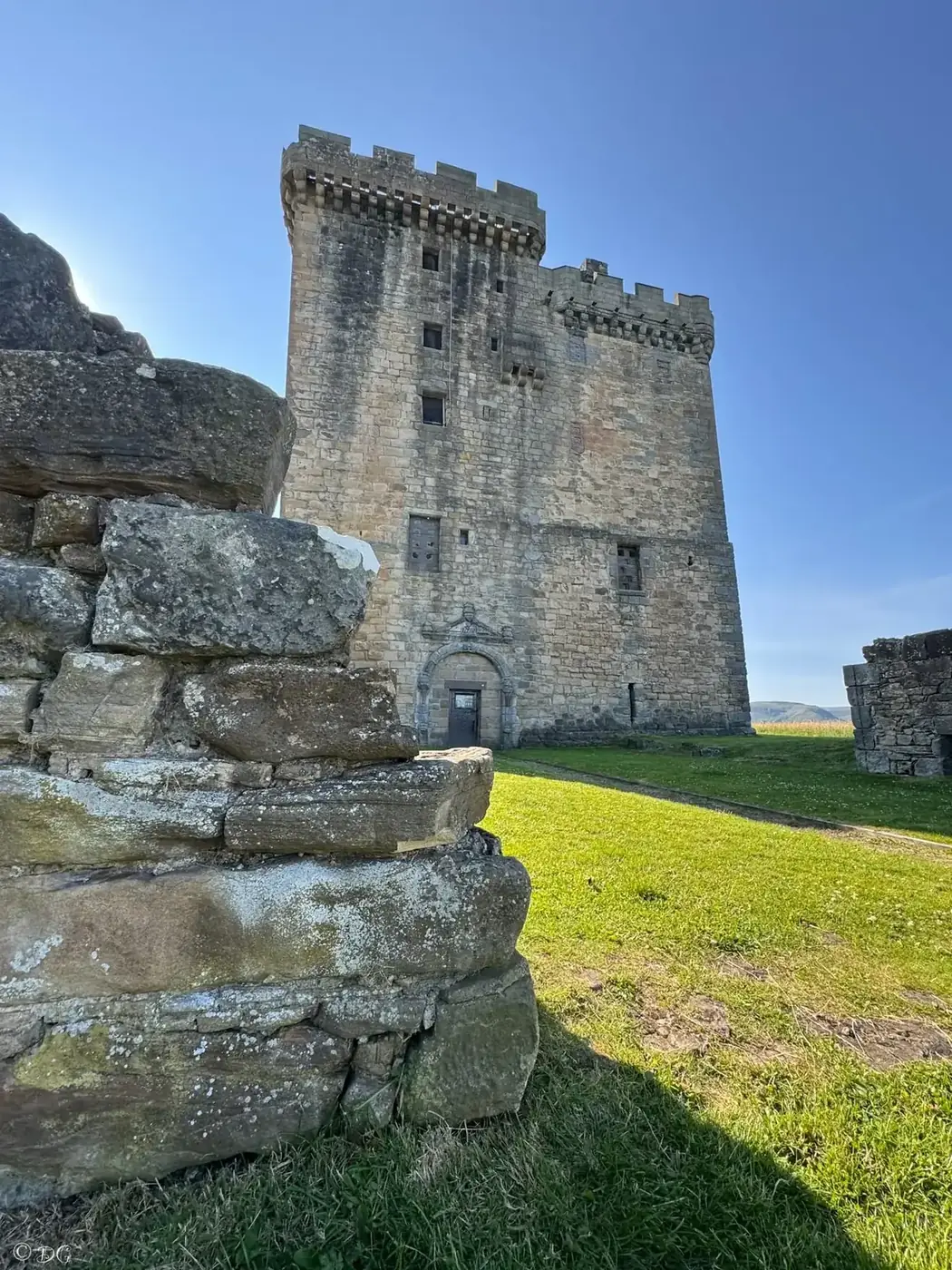
Scotland/Loch Lomond, Stirling & Forth/Clackmannan Tower
FIELD GUIDE · LOCH LOMOND, STIRLING & FORTH
A Scottish castle story. Read through its landscape.
PLAN YOUR VISIT
High Street, Clackmannan, Clackmannanshire, FK10 4EH
VISIT TIME: Allow 20–40 minutesSelected guided tours: £11 adult, £9 concession and £6.50 child. Advance booking is required.
Adult£11.00
Concession£9.00
Child£6.50
The interior opens only for pre-booked guided tours or special open days. Check the HES programme before travelling.
Allow up to 10 minutes on foot. The final approach crosses grass and can be wet or uneven.
Interior tours include steep stairs, low lintels, uneven floors and exposed heights. The route is unsuitable for some visitors with limited mobility.
WHAT TO EXPECT
01 / THE STORY
Clackmannan Tower rises above the town with the weight of a fortress and the proportions of a tall family home. It is far more complete than its missing surrounding mansion might suggest.
The Bruce name brings instant recognition, but the best-known visitor arrived centuries later: Robert Burns, ceremonially ‘knighted’ with a sword said to have belonged to Robert the Bruce.
The position gives the tower a commanding outline and broad views across the surrounding landscape. From outside, the main block and later projecting work reveal a house enlarged over generations.
Interior openings are occasional, so confirm current arrangements. The exterior and setting still make a worthwhile short visit.
In 1359 David II granted Clackmannan to Sir Robert Bruce. He should not be confused with King Robert I, the famous Robert the Bruce, who had died thirty years earlier.
The family connection is genuine. Careful naming prevents one celebrated ancestor from absorbing the lives of everyone who followed him.
Burns visited the elderly Katherine Bruce in 1787. Historic Environment Scotland recounts how she used a sword reputed to have belonged to Robert the Bruce to ceremonially ‘knight’ the poet.
It was a memorable social gesture, not a formal royal honour—and the sword's medieval ownership is attributed rather than proven.
02 / VISUAL JOURNAL
Every photograph on this page was made by CastleScotland during personal field visits.
10 of 14 photographs
01 / THE STORY CONTINUES
Katherine lived in the broader residence associated with the tower. The adjoining mansion was later demolished, leaving the medieval block to dominate the hill.
Imagine the lost accommodation around it. The building was part of a working home, not always a solitary vertical monument.
Mining subsidence caused serious structural damage. Twentieth-century repairs included reconstruction of the east wall.
The intervention kept the tower standing and deserves a place in its story. A medieval monument can be authentic while carrying substantial modern conservation.
03 / MOMENTS IN STONE
David II grants Clackmannan to Sir Robert Bruce. hill above Clackmannan town is essential to the way this castle is understood.
Burns visits Katherine Bruce; the sword story involves an attributed heirloom. David II grants Clackmannan to Sir Robert Bruce.
Structural repairs address mining subsidence. Current access is part of the guide: check the official or local notice before making the final approach.
History and visitor advice: CastleScotland fieldwork and official operator sources.
The building’s vertical form is a useful introduction to tower-house life. Accommodation had to be arranged above and beside other rooms within a relatively compact footprint. Look at the relationship between the main block and its projecting part, and at how openings differ across the elevations. These observations help explain adaptation without requiring an imaginary reconstruction of every chamber. A residence could continue to express inherited status while its occupants adjusted the practical business of living inside it.
The later Bruce household gives the place a more personal history. Henry Bruce died in 1772, and his widow Katherine remained associated with the property until her death in 1791. The adjacent mansion was subsequently demolished. This distinction matters: the loss of surrounding accommodation does not mean that the standing tower was reduced to a few disconnected ruins. A visitor sees one conspicuous survivor of a broader domestic arrangement, and the missing buildings should remain part of the mental picture.
Robert Burns visited Katherine in 1787. HES recounts her ceremonial use of a sword reputed to have belonged to Robert the Bruce to ‘knight’ the poet. The episode should be read as a social gesture involving an attributed heirloom, not as a formal royal honour or proof of the sword’s medieval provenance. It is an engaging story precisely because it brings family memory and national identity together. The qualification preserves its interest without claiming more than the evidence supports.
The tower’s modern survival also involved intervention. Mining subsidence caused serious structural problems, and its east wall was reconstructed during twentieth-century repairs. That history changes the way a visitor should read the stonework. A standing medieval building may include substantial conservation work; survival does not mean that every visible surface has remained untouched. Differences in masonry can invite questions, but an untrained visual impression should not be treated as a precise construction survey or a substitute for recorded repairs.
Clackmannan Tower is scheduled monument SM90073. The designation describes archaeological potential around the standing structure as well as the architecture itself. Empty ground can retain evidence of former buildings and household activity. Follow current arrangements for visits, and distinguish access to the surrounding area from access to the interior. A good exterior inspection is worthwhile on its own, especially when the outline can be seen against the wider landscape rather than cropped tightly around a doorway.
The strongest visit combines the grant, the evolving house, the remembered Burns episode and the work that kept the tower standing. There is no need to add an unsupported sequence of later owners: the previous reference to the Schaws lacked reliable confirmation in the sources checked. Clackmannan already has a distinctive story. Its value lies in a recognisable family residence whose architecture and remembered associations survived alongside significant losses and repairs, not in pretending that the centuries left it unchanged.
08 / EXPLORE NEXT
Find Scottish castles by region, landscape or the stories that bring them to life.
 Loch Lomond, Stirling & ForthCastle Campbell
  The HighlandsArmadale Castle
  Edinburgh & The LothiansAuldhame Castle