TICKETSFree
Free admission; check the official page for current partial closures.
 Beta
Beta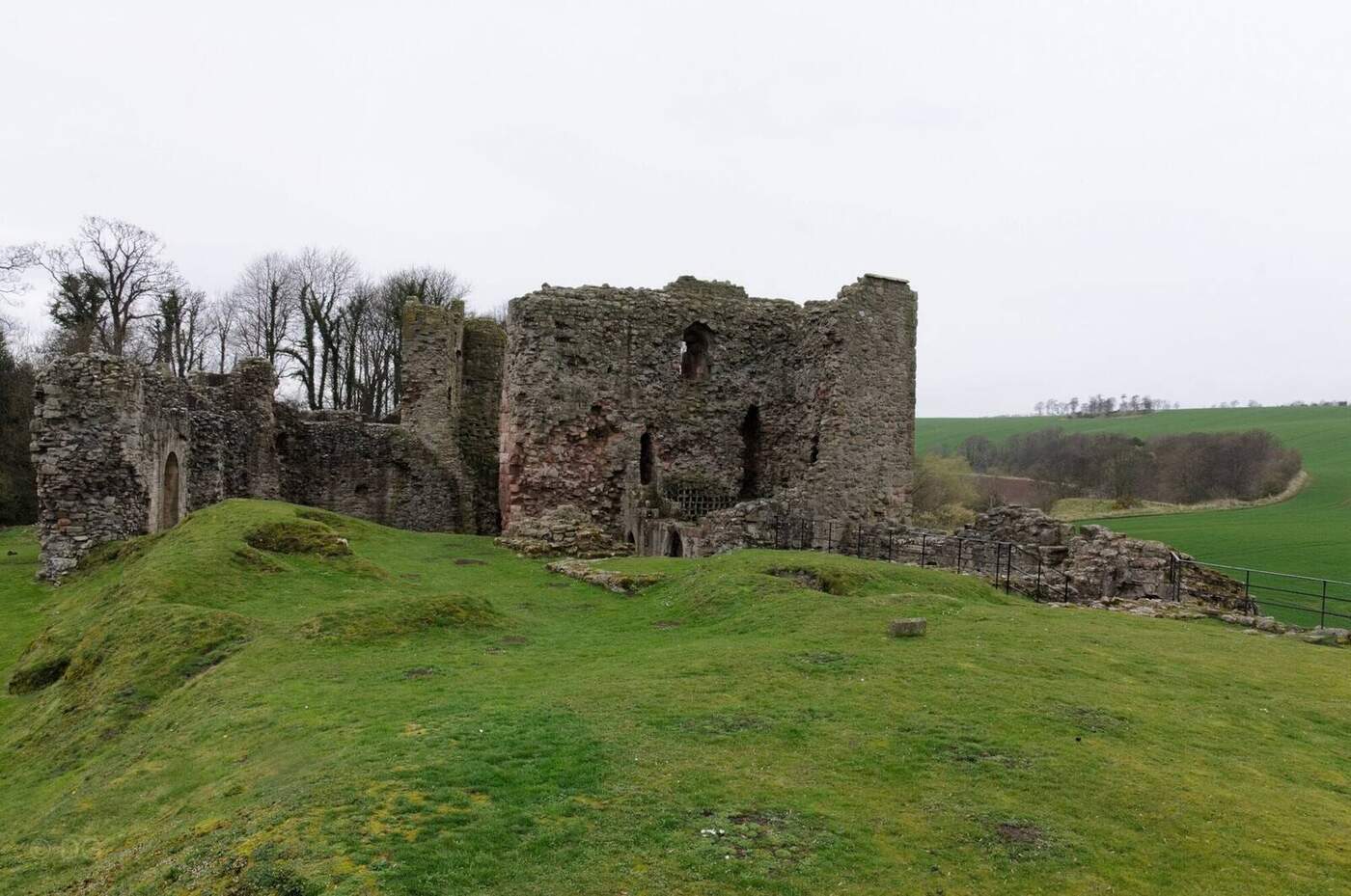
Scotland/Edinburgh & The Lothians/Hailes Castle
RIVER RUIN · EAST LINTON
A riverside stronghold. Layers of East Lothian history.
PLAN YOUR VISIT
Near East Linton, East Lothian
VISIT TIME: 45–75 minutesFree admission; check the official page for current partial closures.
Hailes is free to visit year-round. The official visitor page may list temporary partial closures to individual structures, so check it before travelling.
Use the address and map link above for Hailes Castle. Allow time for the final rural approach and check parking guidance before setting out.
Uneven paths, grass, river-side ground and ruined masonry mean that access is limited. Follow safety notices and keep to open routes.
WHAT TO EXPECT
01 / THE STORY
Hailes sits low beside the River Tyne, reached through trees rather than across a grand esplanade. Red sandstone, grey later walls and flowing water make it feel discovered even though its history reaches deep into national politics.
Some masonry dates to the early thirteenth century. Later Hepburn ownership connected the castle with James Hepburn, Earl of Bothwell, and the final crisis of Mary, Queen of Scots.
This is a ruin to read in fragments. The river, towers and domestic ranges reward changing viewpoints more than one heroic façade.
Access is free, but surfaces can be wet and uneven. Check official notices and let the riverside setting set the pace.
Carefully dressed red sandstone belongs to the early thirteenth-century phase. Historic Environment Scotland says the original builder is unknown despite a traditional de Gourlay association.
Rougher grey Hepburn work helps distinguish later growth. Visual differences guide the story without settling every disputed room label.
Hailes resisted an English siege led by Henry Percy—Hotspur—in 1401. Another siege in 1446 ended in surrender.
Later accounts add sweeping claims about violence during that capture. The sieges are historical; exact dramatic totals require stronger evidence.
02 / VISUAL JOURNAL
Every photograph on this page was made by CastleScotland during personal field visits.
10 of 13 photographs
01 / THE STORY CONTINUES
The Protestant preacher George Wishart was briefly imprisoned at Hailes in January 1546 before being taken to St Andrews and executed for heresy.
That short stay gives the pit prison and domestic ranges a human story without claiming the exact chamber he occupied.
In May 1567 Mary and Bothwell stayed at Hailes while travelling from Dunbar towards Edinburgh. They married at Holyrood, not here.
The visit places the castle inside a political crisis that soon ended Mary's personal rule. Precise language keeps Hailes important without moving the wedding for effect.
03 / MOMENTS IN STONE
The earliest surviving masonry is built; the founder is uncertain. The Tyne is more than scenery; it defines the experience of the ruins.
The Hepburns acquire Hailes. The Hepburn name links Hailes to one of the Stewart era’s sharpest political dramas.
Mary and Bothwell stay here before their marriage at Holyrood. Several centuries of change remain readable across the broken ranges.
Cromwellian occupation ends the castle’s principal residential role.
04 / FIND THE CASTLE
55.973219,-2.683153
Hailes Castle is at Near East Linton, East Lothian. Check current access arrangements before travelling.
Open mapHailes is free to visit year-round. The official visitor page may list temporary partial closures to individual structures, so check it before travelling.
Use the address and map link above for Hailes Castle. Allow time for the final rural approach and check parking guidance before setting out.
The best images combine stone with the Tyne; walk both sides of the approach and use the bridge and water as compositional lines.
History and visitor advice: CastleScotland fieldwork and official operator sources.
Look first for the carefully dressed red sandstone along the river. This belongs to the earliest surviving phase, including parts of a rectangular keep and a separate well tower. Much of the later Hepburn work uses rougher grey masonry. The contrast gives visitors a way to distinguish building campaigns without pretending that every fragment has a settled interpretation. HES questions the older description of the first castle as a neatly arranged hall flanked by towers.
The Hepburns created a substantial tower house at the western end of the enclosure. Its accommodation rose above a storage basement and a pit prison. Between this tower and the older keep, a complicated domestic range has often been called a chapel. HES considers an original great hall more likely. Ovens and a stone trough also point to service activities below. These competing interpretations are part of the interest: a familiar label does not make a room’s function certain.
The castle resisted an English siege led by Henry Percy, known as Hotspur, in 1401. Another siege brought surrender to Archibald Dunbar in 1446. Later accounts describe extreme violence during that capture, but their sweeping language should not be repeated as a verified count of deaths. In January 1546, the Protestant preacher George Wishart was briefly imprisoned here before being taken to St Andrews, where he was executed for heresy.
James Hepburn’s association with Hailes is secure as a residence and family stronghold. His alleged birth here is less firmly established and is best treated as a local association rather than a documented fact. In May 1567, Mary, Queen of Scots and Bothwell stayed at Hailes while travelling from Dunbar towards Edinburgh. Their marriage took place at Holyrood, not at this castle. The visit connects Hailes directly with a crisis that soon ended Mary’s personal rule.
The invasion of 1650 and the damage associated with Cromwell’s troops effectively ended Hailes’s role as a noble residence. This was not the end of all human use: later tenants occupied parts of the old castle for housing and storage. It entered state guardianship in 1926 and is protected as a scheduled monument. HES’s assessment also identifies important unanswered archaeological questions, particularly concerning the early enclosure and surrounding settlement.
Walk slowly through the accessible remains and compare the walls before looking for a single definitive story. In wet weather, the river and stone give the ruin exceptional texture; in clear light, the setting makes its fragmented plan easier to trace. Follow current access notices and check the official visitor page before travelling.
08 / EXPLORE NEXT
Find Scottish castles by region, landscape or the stories that bring them to life.
 Edinburgh & The LothiansAuldhame Castle
  Edinburgh & The LothiansDunbar Castle
  Edinburgh & The LothiansRedhouse Castle