TICKETS£18.00
Tower access can change during structural repairs; confirm the current visitor notice before travelling.
 Beta
Beta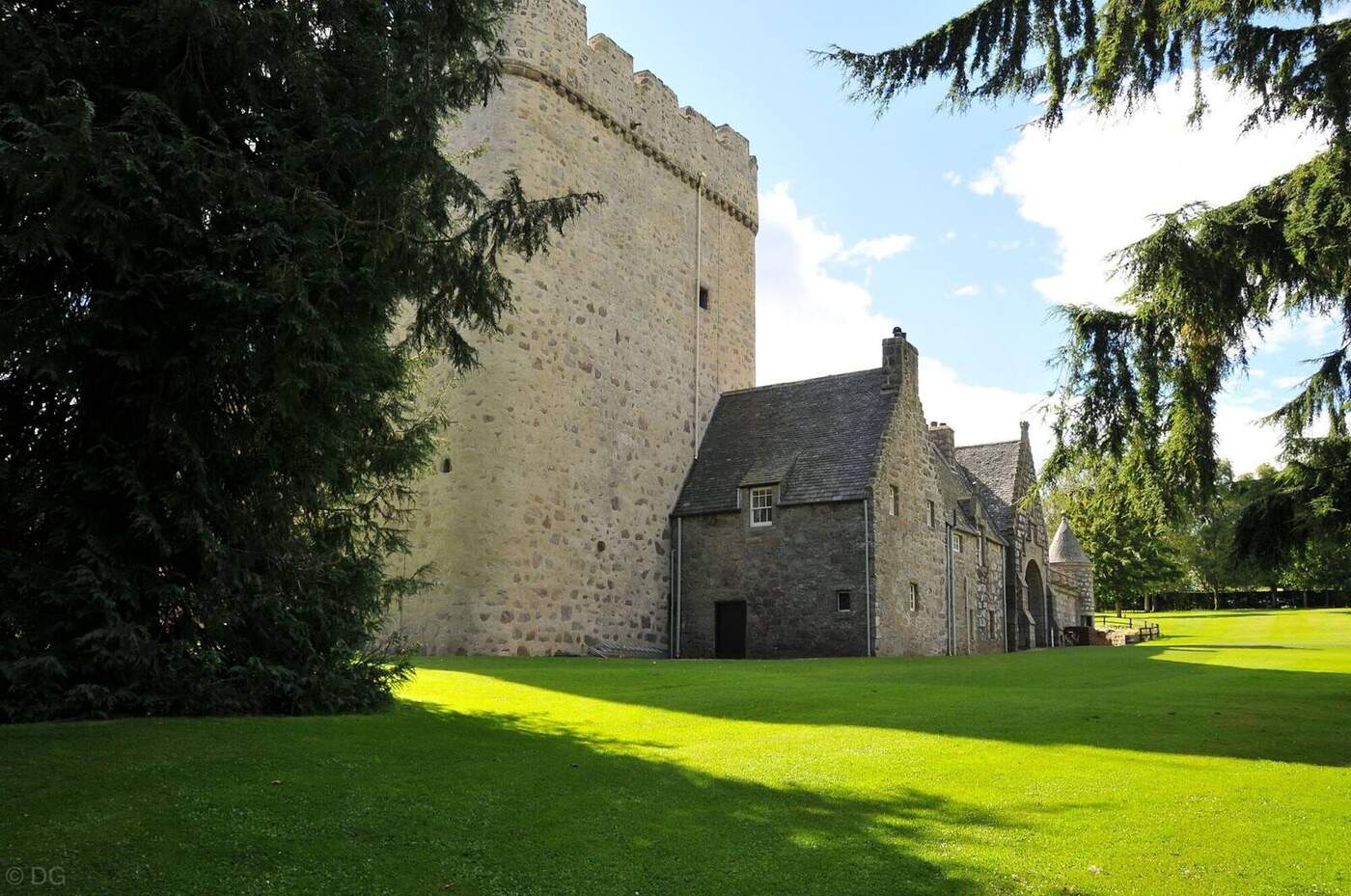
Scotland/Aberdeenshire/Drum Castle
ANCIENT TOWER · ROSE GARDEN
A medieval tower. More than six centuries of family history.
PLAN YOUR VISIT
Drumoak, Banchory, Aberdeenshire, AB31 5EY
VISIT TIME: 2–3 hoursTower access can change during structural repairs; confirm the current visitor notice before travelling.
The historic tower can have temporary restrictions for structural work; check the daily visitor notice before leaving.
Use the address and map link above for Drum Castle. Allow time for the final rural approach and check parking guidance before setting out.
The estate includes historic stairs, uneven garden routes and woodland paths. Ask the Trust about current step-free access and any tower closures if mobility is a concern.
WHAT TO EXPECT
01 / THE STORY
Drum Castle looks like several centuries decided to share one address. A massive medieval tower stands beside a later mansion, while gardens and woodland soften the edges of both.
The Irvine family remained connected with Drum for more than six centuries. That continuity did not freeze the house in time. It produced new rooms, new tastes and one of the most inviting libraries found inside an old Scottish tower.
Drum suits visitors who want architecture, interiors and a garden walk in one stop. The contrast between the old tower and later house is visible before you go inside.
Allow enough time for the grounds, especially when the rose garden is in season. This is an estate visit rather than a single viewpoint.
The great tower is usually dated to about 1280–1300. Robert the Bruce granted Drum and its royal forest to William de Irwyn in 1323.
Those dates are related but not identical. The grant begins the documented Irvine connection; it does not prove that Bruce commissioned the surviving tower.
Around the 1840s, the lower hall of the old tower was transformed into a library. Bookshelves and comfortable domestic use took over a space created centuries earlier.
That is one of Drum’s best visual surprises. The room shows how an old defensive building could be absorbed into a changing family home instead of being abandoned as an inconvenient relic.
02 / VISUAL JOURNAL
Every photograph on this page was made by CastleScotland during personal field visits.
01 / THE STORY CONTINUES
The estate suffered during seventeenth-century conflict, and support for the Stuart cause later brought further difficulties to the family.
Yet the house kept changing. A large mansion wing appeared in 1619, and nineteenth-century alterations reshaped the courtyard and routes through the building.
The garden tells a later, more peaceful chapter and gives the heavy tower room to breathe. Look back from the planting to see how different periods join together.
Check the National Trust for Scotland’s current opening arrangements before travelling, as interior access and seasonal areas can vary.
03 / MOMENTS IN STONE
Robert the Bruce grants Drum to William de Irwyn. The 1323 grant anchors the family story in Scotland’s medieval political landscape.
A substantial mansion wing is added. The library makes the later country-house identity as vivid as the ancient tower.
The tower’s lower hall is adapted as a library. The garden gives the estate a seasonal chapter that is worth planning time for.
Further alterations reshape the courtyard and access.
The property passes to NTS; published accounts differ by a year.
04 / FIND THE CASTLE
57.095028,-2.337811
Drum Castle is at Drumoak, Banchory, Aberdeenshire, AB31 5EY. Check current access arrangements before travelling.
Open mapThe historic tower can have temporary restrictions for structural work; check the daily visitor notice before leaving.
Use the address and map link above for Drum Castle. Allow time for the final rural approach and check parking guidance before setting out.
Use the rose garden to soften the hard medieval tower, then look for a side angle that shows the meeting of the old block and Jacobean house.
History and visitor advice: CastleScotland fieldwork and official operator sources.
The medieval building combined household life with security and visible authority. Its walls have rounded corners, while the principal entrance was originally above ground level. Vaulted spaces were subdivided by timber floors, making the interior more complex than an empty stone shell suggests. The National Trust’s architectural discussion cautions against treating every small opening as a weapon position: light, ventilation and weather protection also shaped the design.
The original grant concerned land and the royal forest, connecting the family’s position with management of a wider landscape. It is tempting to attach a famous medieval architect to such an early tower, but an attribution to Richard Cementarius remains a suggestion rather than an established building contract. Drum does not need a certain architect’s name to demonstrate the ambitions of a substantial medieval residence.
A major expansion in 1619 added the mansion associated with the ninth laird. The larger windows and more extensive accommodation offered a different way of living alongside the tower. Later changes around 1800 altered the entrance and windows, while nineteenth-century work reshaped the courtyard and circulation. HES associates the 1875 alterations with David Bryce and his nephew John Bryce. These layers explain why the castle cannot be read as one untouched medieval plan.
The library is a particularly clear example of adaptation. Created around the 1840s within the old tower’s lower hall, it inserted a later domestic purpose into a much older volume. Look at it as evidence of continued use rather than a medieval room furnished exactly as it had always been. Books and stone belong to different chapters that now coexist within the same building.
Family continuity did not mean uninterrupted prosperity. The HES landscape history records damage by the Earl of Argyll’s troops during the seventeenth-century conflicts and later difficulties linked to support for the Stuarts. It also records renewed gardening activity in the late eighteenth century. The present landscape developed through such changes; the rose garden should not be imagined as a complete survival of the medieval royal forest or of an unchanged seventeenth-century layout.
There is a small discrepancy in published transfer dates. The National Trust dates its acquisition to 1975, while the HES landscape record gives 1976 for an earlier agreement taking effect. Both place the transition in the mid-1970s. Drum is now cared for by the Trust and is a category A listed building, with a separately designated garden landscape. Its interest lies in the relationship between these parts: an old tower, a changing family home and grounds that continued to evolve. Check current access arrangements before planning an interior visit.
08 / EXPLORE NEXT
Find Scottish castles by region, landscape or the stories that bring them to life.
 AberdeenshireDunnottar Castle
  AberdeenshireHuntly Castle
  AberdeenshireKildrummy Castle